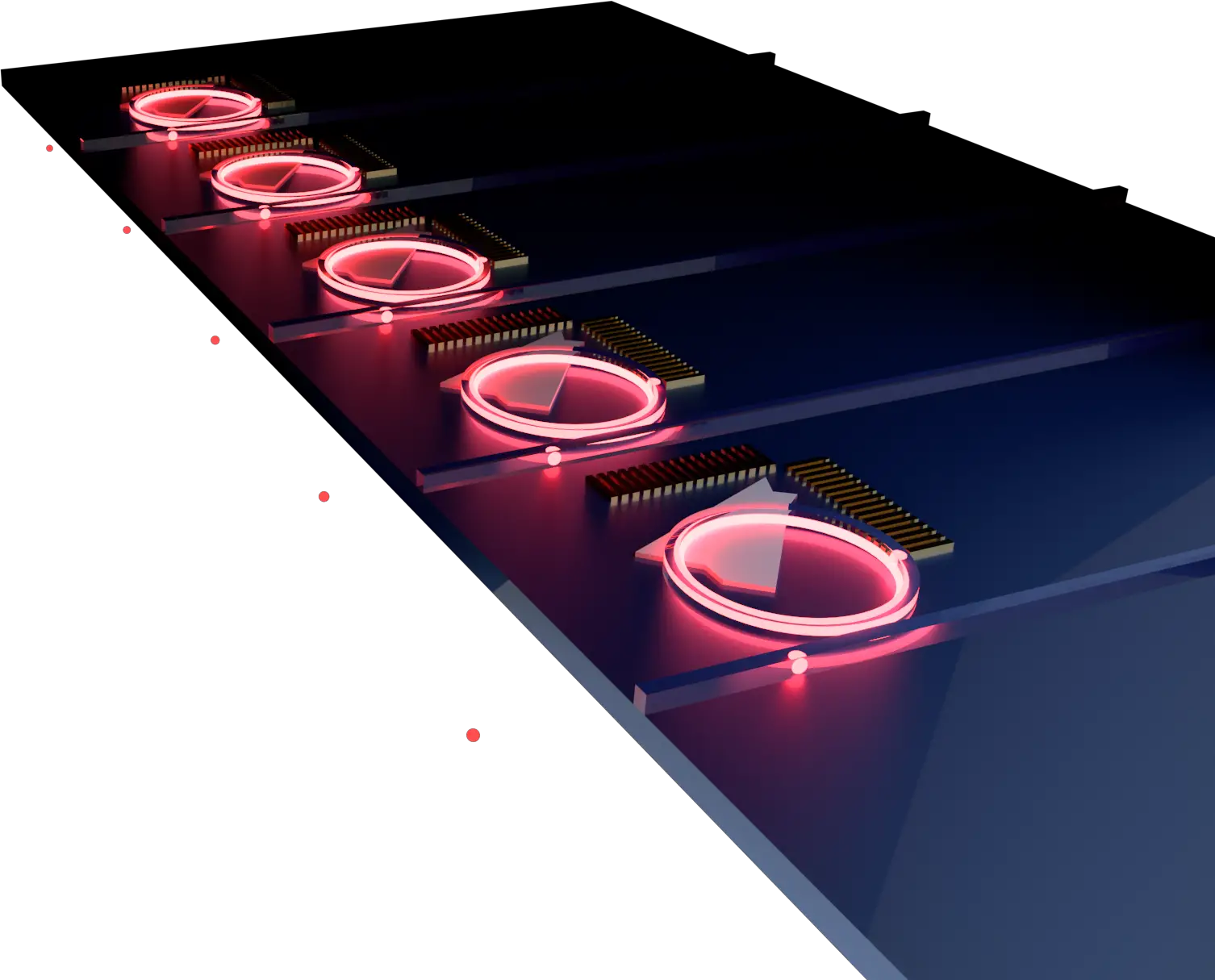
"An array of on-demand single-photon sources deterministically integrated with silicon-based photonics, created from the hybrid integration of 2D materials with silicon nitride resonators. Credit: The Moody Lab, UCSB" (Scitechdaily.com/Quantum Breakthrough: A New Method for On-Chip Generation of Single Photon)
The use of single photons can revolutionize long-distance communication even if the system uses regular bits.
The problem with quantum computers and extremely secure quantum communication is producing photons with the necessary accuracy. The quantum communication system can also use photon pairs as regular bits.
If we want to use single photons in binary communication that makes communication unbreakable. If we minimize the number of used photons in long-distance laser communication. That minimizes the risk that third parties catch information.
How single photons describe a bit. In regular bit is two states zero and one. And there is possible to benefit single photons in that kind of long-distance communication.
Using photon pairs
If the system sends one photon, the value of the bit is zero.
If the system sends two photons, the value of the bit is one.
Use photon tracks.
If the photon travels in track one, the value of the bit is zero.
If a photon travels in track two, the value of the bit is one.
Those methods can use in photonic binary processors that are required for the support system that adjusts the quantum processors. That method can also use to transmit data in the quantum computer. In the system is a laser that tells if the power is on.
And then, the system can use a certain number of tracks for making the qubit. But if the system needs maximum power it can also make quantum entanglements and superpositions inside those photons. In that kind of quantum system, there are two modes. The tracks are the lower power, and in maximum power, that kind of quantum computer also uses photon's internal quantum states.
The two-mode quantum system diagram.
A laser that tells if the system is on and off.
Track 1
Track 2
Track 3
....
The idea is that in lower modes the quantum system just hovers qubit. And in that mode, each track is the qubit's certain state. And if the system requires maximum power, it can turn photons into superposition.
The idea in binary quantum communication is that if the sender sends one photon the value is zero. And if it sends two photons. The value is one. Another version is to use a certain photonic- or quantum channel. If a photon travels in channel number one the value is zero. And if the photon travels in channel two, the value is one.
The new system for producing photons is introduced in the article in the link below this text. The ability to create single photons makes it possible to create new quantum components. And one of them is the quantum router.
The idea of the quantum router is that there is a photonic or electron ring. Then there is the thing like a hydrogen atom that is locked in the middle of the ring. There is the possibility that the laser can lock electrons in a certain position. Then laser ray injects power into the proton. And that energy will transfer to the electron. Then that photon acts like a quantum stylus, that sends photons in the right direction.
https://scitechdaily.com/quantum-breakthrough-a-new-method-for-on-chip-generation-of-single-photon/
https://astronomyandtechnology.blogspot.com/