Showing posts with label distant galaxies. Show all posts

Wednesday, February 15, 2023

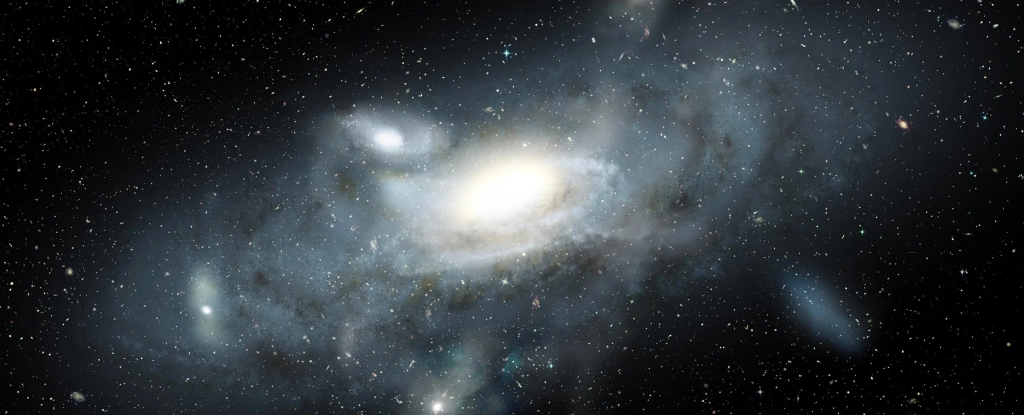
Astronomers found a similar galaxy with milky from billions of light years away.


"An artist impression of our Milky Way galaxy in its youth. The Sparkler galaxy shows similar activity to an infant Milky Way. (James Josephides/Swinburne University/CC BY 4.0)" (ScitechDaily.com/Astronomers Find 'Mirror Image' of The Milky Way From Billions of Years Ago)


Astronomers can see the past by looking at objects that are billions of lightyears away from the Earth. So when we see galaxies from another side of the universe we see what happens to them billions of years ago. Same way as we see what happens in Alpha Centauri four years ago because the distance to Alpha Centauri is about 4 ly. We see what happened in a distant galaxy 12 billion years ago if the distance to that object is 12 billion light years. 

That caused an idea about the possibility that maybe. Someday we can see ourselves in the past. The thing requires the reflecting cloud at a certain distance. So theoretically, if we want to see what happened 100 years ago we must find the reflecting cloud that is 50 ly from Earth. 

The reason for that is that light must travel in both directions. Black holes or icy clouds can make the light reflect and that means someday in the future we can see our galaxy in the past. Black holes can make radiation make the U-turn. That means the same information that was left from some planet could return to the point where it was left. 

The real problem is that the reflection must be so accurate that we can detect our planet from that reflection. And maybe there is no possibility to use that thing to see the past and see what happened on Earth. But large size reflecting clouds or black holes can turn radiation back where it came from. And there is the possibility that someday we can see the reflection from our solar system or home galaxy in its youth. 


https://www.sciencealert.com/astronomers-find-mirror-image-of-the-milky-way-from-billions-of-years-ago


https://astronomyandtechnology.blogspot.com/

Sunday, January 22, 2023

The gravitational waves can bring us back to the point where everything began.


Gravitational waves are a new tool for researching the universe astronomers observe the most distant objects. To find things that happened a long time ago. 

Gravitational waves can tell about things that happen behind a black hole's event horizons, but they can also use to detect black holes.  If a black hole's transition disk is weak. 

Or if its distance is very long. It's possible that X- and Gamma ray radiation. That comes from the black hole disappearing in X- and Gamma-ray background. 

Galaxy GN-z11 is the most distant galaxy that we ever saw in history. The distance to that galaxy is 38 billion light years. So we see what happened in that galaxy 38 billion years ago. 

The reason why researchers are observing extremely distant galaxies is that particles that are traveling across the universe are taking plague to their core. That plague involves information about the universe that the particle touched. 

Another reason that those distant galaxies can uncover is the place. Where the Big Bang happened. There is a possibility that at that point is the black hole that stored the information about the Big Bang.  If that hypothetical supermassive black hole in the center of the universe is real. This thing would be the biggest event in the history of cosmology, 

But even the most distant galaxies will not help us to see the event called the Big Bang. The reason for that is simple. Those galaxies formed after the Big Bang. 

But can we find the Big Bang? Or can we get information about that event? There is one little possibility to see the photons or something. That are remnants of the Big Bang. 

The theory of the Big Bang goes like this. All visible material and energy in the universe are released in this event. 

Theoretically, it is possible. That part of that material and energy formed a black hole. If researchers can find the first black hole. There could be stored photons that involve information about the Big Bang. 

The idea of this hypothesis is that the black hole can trap some photons at the point of the event horizon. The time is not moving at that point. So black holes can store information from the Big Bang. But there is one requirement. The black hole must be formed during the Big Bang. Otherwise, it cannot trap the right photons. 

When we think about the first photons or information that Big Bang released we cannot see that information because that information travels away from us. The problem with photons is that we cannot see them from backward. We can see photon that travels to us.

But we cannot see photons. That travels in the opposite direction to us. Or we cannot see photon that travels ahead of us. There is a possibility that we can see the photons that are stored in the event horizon of the black hole. The gravitational waves of extremely old black holes can tell many things about the chaotic young universe. 

When the universe was very young and hot it was a chaotic mixture of photons, electrons, and other elementary particles. Then there was formed the central. That central could be a black hole that formed. The first whirl in the chaotic universe in which the temperature was extremely high. The whirl created the sub-whirls in the chaotic quantum-gluon plasma. And maybe those whirls formed material. 


https://scitechdaily.com/revealing-the-start-of-time-itself-ripples-in-the-fabric-of-the-universe-may-peer-back-to-the-beginning-of-everything-we-know/


https://en.wikipedia.org/wiki/GN-z11


https://astronomyandtechnology.blogspot.com/
Could there have been UFOs in Earth's orbit in the 1950s?

Aligned, Multiple-Transient Events in the First Palomar Sky Survey could be artificial objects. Or. They could also be some light reflection...