Showing posts with label green energy. Show all posts

Sunday, February 12, 2023

Hydrogen production is a key element for the hydrogen economy.


Hydrogen production is one of the biggest problems for the hydrogen economy. Removing carbon from hydrocarbons is not very difficult. The idea is that the system uses an active carbon filter. That filter can remove carbon from the communal waste. 

But the problem is where the system puts that carbon. In one of the most futuristic versions, the pressure system could crystallize that carbon and make carbonite crystals called industrial diamonds. But that system requires energy. And energy is the biggest problem in producing commercial hydrogen. 

One of the things that can solve this problem is wind or any other clean energy that can use to split seawater electrolytically. The system also produces sodium and chorine. The hydrogen ions and chloride anions travel to different electrodes. 

And the sodium ion will stratify to the same electrode that produces hydrogen. This thing makes it possible to produce chlorine and sodium in the same factories that produce hydrogen. Also, those platforms can produce pure oxygen for many purposes. 


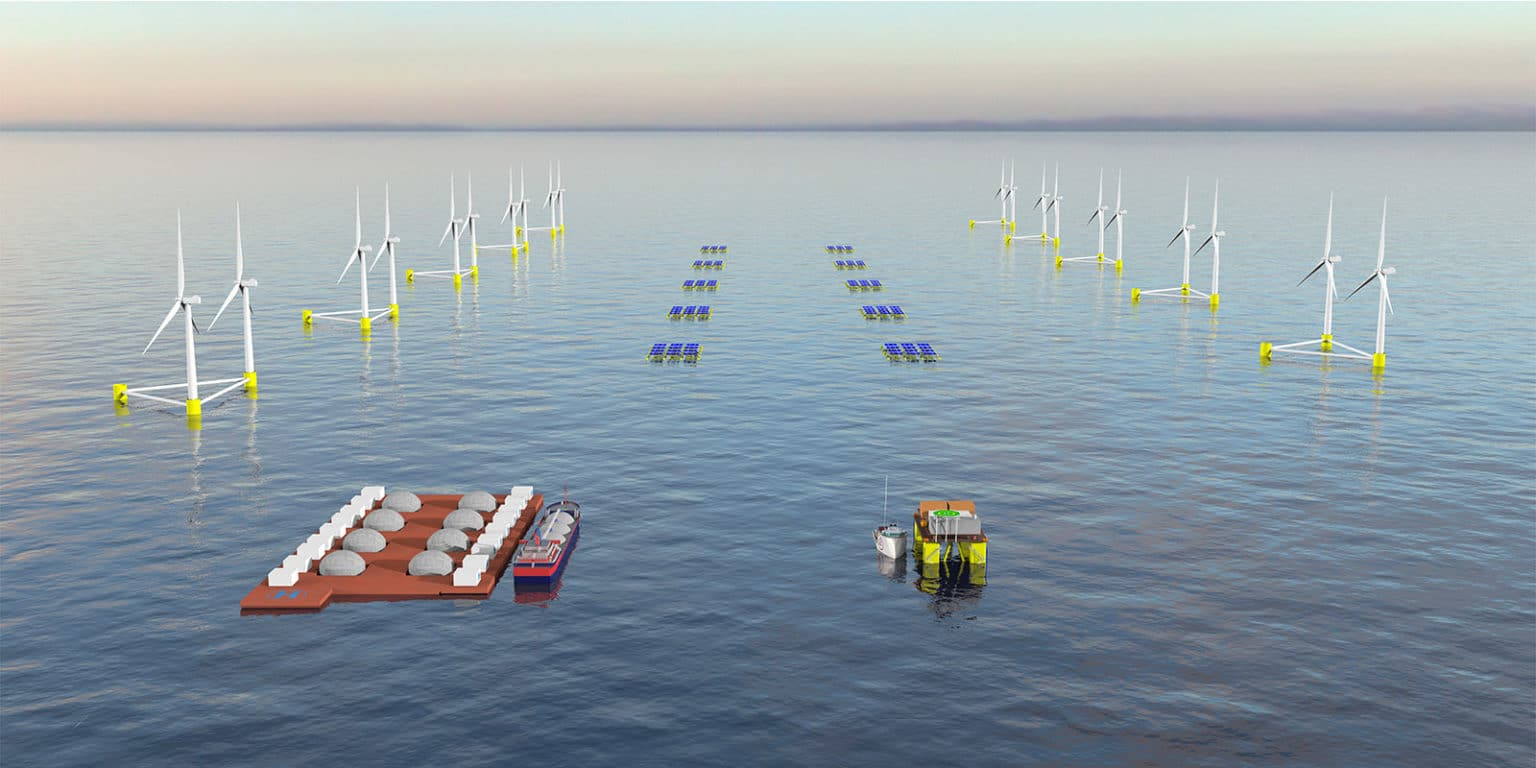
Energy islands offshore energy production. 


But then we can think about floating solar panels or floating platforms, there are solar panels and tubes with turbines. The idea is that when the tube is upward at the bottom of the sea or lake, the capillary effect pulls water through it. Then that water flow will rotate the generators. Those floating energy islands can offer free energy for people. The fact is that this energy can use to split water molecules. 

Or the system can drive it to the batteries or capacitor-based energy storage. If the system drives energy into the network through energy storage, that will act as a residual-current device. That protects the electric network from errors. And it stabilizes the tops and bottoms in energy use.  

When there are sunny or windy days. The system can produce energy for storage. And when the level of sunlight or wind is low, the system can deliver energy from those storages. In that case, I must say that if there are capillary tubes in some lakes they can produce electricity. Without the need to care about the weather. 


https://www.pv-magazine.com/2021/01/15/offshore-hydrogen-production-powered-by-floating-pv/


https://en.wikipedia.org/wiki/Hydrogen_production


https://astronomyandtechnology.blogspot.com/

Tuesday, January 17, 2023

The next-generation biological solar cell could be useful in green energy. And in the power supply of manned space stations

Right) "The ice plant succulent shown here can become a living solar cell and power a circuit using photosynthesis. Credit: Adapted from ACS Applied Materials & Interfaces, 2022, DOI: 10.1021/acsami.2c15123" (ScitechDaily.com/Scientists Have Developed a Living “Bio-Solar Cell” That Runs on Photosynthesis)


The long-term space mission that is limited inside the asteroid belt is also challenging. The spacecraft or space stations can travel between Mars and earth by using ion motors that get their electricity from solar panels. Also, the Mars- and moon stations can use solar panels for energy production. The same technology that is used in Mars or Moon stations can use in the isolated research stations on Earth. 

And places like Antarctica can use to develop this kind of technology. The idea is that those stations are used to test things like closed-cycle life-support. If food can produce at the moon station, that radically decreases its costs. And moon station can use to test the technology, that is needed for the Mars station. 

There is a possibility that spacecraft or space station gets at least part of their electricity from a biological source. In this case, biological solar cells can use along with regular solar panels. When we think about the use of biological solar panels at isolated places, that thing makes the station more energy efficient than before. Even in the dark seasons the ability to recycle part of the energy that is used in the greenhouse. 

That is producing food is making the system more energy efficient. The solar-power can use along with things like wind generators. And in the summertime in Antarctica, the operators can fix wind generators when solar panels are used to make electricity. Also, biological solar panels can recycle part of the energy that is used in greenhouses. 

But the thing is that the living solar cells that are photosynthetic and can create electricity from living vegetables are an interesting alternative. In that case, the same system can create electricity, it can clean the air by using photosynthesis. And that kind of living solar cell can also offer nutrients for the spacecraft's or space station's crew. That thing allows using limited space more effectively than otherwise. 

Developing green energy is important. And always at the beginning of the system is in small-scale systems. But then those systems can escalate to everyday use. 

https://scitechdaily.com/scientists-have-developed-a-living-bio-solar-cell-that-runs-on-photosynthesis/

https://astronomyandtechnology.blogspot.com/

Could there have been UFOs in Earth's orbit in the 1950s?

Aligned, Multiple-Transient Events in the First Palomar Sky Survey could be artificial objects. Or. They could also be some light reflection...