Showing posts with label Quantum computers. Show all posts

Monday, February 13, 2023

Perovskite can use in a new type of quantum- and nanotechnology.


"The Advanced Materials cover illustration shows the surface of the halide perovskite structure being modified by a large organic cation. The cation diffuses through the thin film to reconstruct the surface structure. Credit: Advanced Materials"  (ScitechDaily.com/Revolutionizing the Future of Energy: Advancement in Halide Perovskite Solar Cell Technology)

Perovskite can have multiple uses in nano- and quantum technology. 

Perovskite can use in advanced nanotechnical armor. When something hits the structure. That is in the picture above this, it presses the upper cubes flat. That ties impact energy while ammunition penetrates the core. And because the material is elastic. Ammunition transmits energy slower to that material than to regular steel. That makes this type of nanotechnical armor more effective than regular armor. 

Perovskite can use in a new type of quantum technology. It can revolutionize solar panels. But that structure can also make it possible to create a new type of scanning tunneling microscopes or quantum computers. And perovskite can make gamma-ray lasers possible. 


Perovskite structure makes a new type of solar panels possible. 


Perovskite is a cube standing on its tip, as you can see from the image at the top. And that structure makes the solar panel more effective. The tapered tip conducts energy to the bottom of the structure. 

And that structure also collects energy from the top to the structure's tip. The perovskite structure is also interesting in the tools like the scanning tunneling microscope and quantum computer. 


Scanning tunneling microscope. 


The perovskite can use to hover ions or electrons over the layer. The scanning tunneling microscope uses the hovering particle for measuring details in materials. But the problem is that the observation area of the tunneling microscope is very thin. 

The perovskite structure allows making lots of observation pikes for scanning tunneling microscope. And that thing makes it possible to observe larger areas with incredible accuracy. 


Perovskite can also use in nanotechnology. 


The perovskite structure allows creating the new type of systems for nanotechnology. The system can use similar technology to scanning tunneling microscopes. The system anchors the nano-size particles between the layers. And the perovskite forms the pylons that keep the layers of that nanosystems away. 

Then the system positions nanomachine parts in the right position by shooting them with lasers and magnetic fields. To make this process successful. The system must know each particle's position and its location in the system. So that requires ultimate highly accurate observation systems. 


Perovskite in quantum computers. 


Perovskite can use to position the electrons in the right positions in the quantum computer. The system puts electrons to hover at the tip of the perovskite. Then the laser ray will make the channel between those electrons. In that case, the electromagnetic shadow between those electrons will make the channel between them. Then the system shoots energy impulses to them. 

And that should form photon pair between those electrons. Then the system will superposition and entangle those photons. The electrons form an array that sends and receive information to and from that quantum entanglement. The perovskite structure makes it possible to create multiple quantum entanglement lines that are acting at the same time. 


And finally, perovskite can make it possible to create gamma-ray lasers without the need for annihilation.


If the electron stick of superpositioned and entangled electrons that are forming the gamma-ray laser's laser element can position straight in the middle of the perovskite crystals. That would be a very powerful system. If energy impulses to those lined electrons can give straight from perovskite. 

That makes the system more powerful than if the system must use some ion or electron layer as the energy aimer. The lined perovskite crystals can use to aim energy impulses straight at the laser element. Regularly gamma-ray lasers use electron or ion clouds to make energy pulses. 

The idea is that the system will anchor electrons or negative ions to the tip of perovskite. Then in the middle of that system is the line of superpositioned and entangled electrons. Because the energy level on another side of that electron line is higher than the other, the system can aim an energy burst in the wanted direction. 

Then the system will aim energy impulses at those ions or electrons that hang around that electron stick. When energy pumping ends the system those ions send the energy impulse to those electrons. 


https://scitechdaily.com/revolutionizing-the-future-of-energy-advancement-in-halide-perovskite-solar-cell-technology/


https://astronomyandtechnology.blogspot.com/

Saturday, February 11, 2023

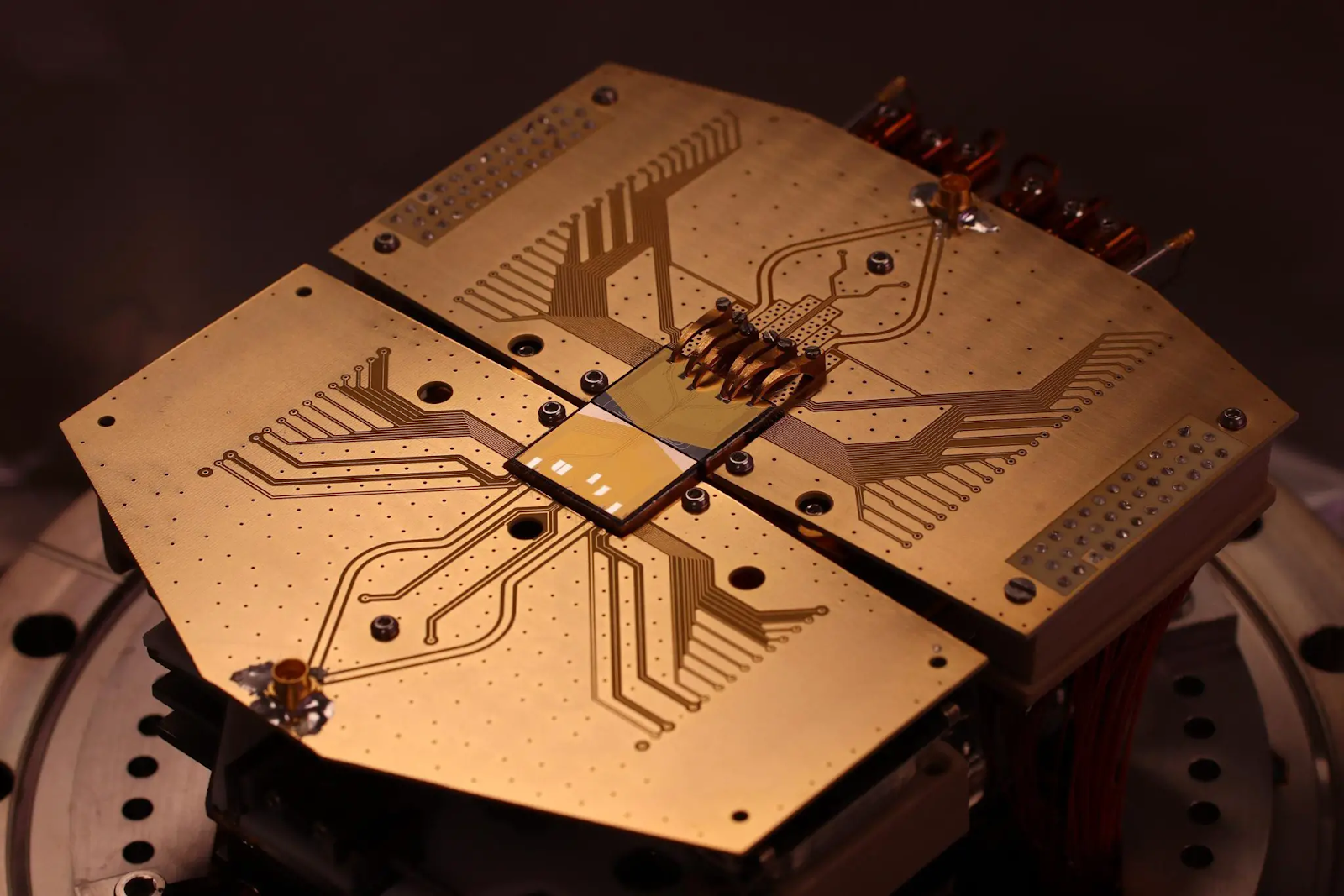
A breakthrough in quantum computing allows transferring of data between two quantum chips.


"Quantum computer setup at the University of Sussex with two quantum computer microchips where quantum bits are transferred from one microchip to another with record speed. Credit: University of Sussex" (ScitechDaily.com/Major Breakthrough in Developing Quantum Computers That Can Solve Critical Challenges of Our Time)

The requirement for successful quantum computing is that the system can operate without breaks. Error detection can create by using two or more quantum computers. But how to make quantum computers operate without breaks? And the problematic thing is that quantum entanglement and superposition that quantum computer use remains only less than a minute. Then the system must adjust the quantum entanglement again. 

The transmitting side of quantum entanglement must be at a higher energy level than the receiving side. Or the information is not traveling in that system. When both sides in quantum entanglement reach the same energy level. 

That breaks the quantum entanglement. Sometimes the situation where quantum entanglement reaches the same energy level is called a filling. When both sides of quantum entanglement reach the same energy level the quantum entanglement fills. And that forms the standing wave between those superpositioned and entangled particles. Then that standing wave kicks those particles away. 

*************************************

The quantum computer is: 


1) Quantum processors 


2) Co-processors (AI-controlled support systems) predict when quantum entanglement turns to a stable energy level. And drive information to the second quantum processor when the quantum entanglement in the first processor starts to break. 


Another purpose of the support system is to start adjusting the second processor at the right moment. Data jumps between those two quantum processors. And that makes it possible to use quantum computers without breaks. 


If the system can predict the moment when quantum entanglement fills. Or both sides of quantum entanglement reaching the same energy level would make it possible to create a quantum computer that operates without breaks. 

*************************************


The idea is: when quantum entanglement starts to fill. The system starts to adjust the second quantum processor. And then drive data to the second processor that continues the first processor's work. The fact is that the filling of the quantum entanglement will not happen in a moment. When the energy levels between the ends of quantum entanglement are closing each other data flow between those particles will be slowing. And the support system that observes the quantum entanglement starts to adjust the second processor and drive data in it.  

The best way to solve this problem is to use two quantum processors side-by-side. When the quantum entanglement starts to fill, that means it starts to reach an energy balance the first quantum chip can transmit the information to the second quantum chip. And that thing continues the operation. 

The breakthrough is that the quantum system can transfer data between two quantum chips without limits. And that makes revolution for computing. Quantum systems are effective tools. But that technology is still young. If we want to use quantum computers for something else than purely theoretical work, the major problem is how to handle breaks. If some computer controls robots. It requires non-stop operating capacity and perfect error management. And that new system can make break handling more effective. 

https://scitechdaily.com/major-breakthrough-in-developing-quantum-computers-that-can-solve-critical-challenges-of-our-time/

Friday, January 20, 2023

The digital "demon": how to increase the quantum computer's power? (Part2)


The key element in qubit is how users can be sure that its value is zero before the system starts to transfer data to it. The normal way is to decrease the temperature of the qubit to zero kelvin. In fact. That thing is probably not necessary in the future. 

The system can take any temperature or energy level to zero point. The zero point could be, for example, 20 degrees Celsius. 

The zero point is the point. Where the system starts to transfer data to the qubit. The problem with high-temperature qubits is how to control their oscillation. But if the system can keep the energy level stable that thing can revolutionize quantum computing. When zero-point is determined. The system can make superpositions and entangled pairs of elementary particles. 

And then the system will operate for a while. The problem is that the energy level between both ends of quantum entanglement must not be the same. 

If the energy level of superpositioned and entangled particles is the same. That thing breaks the quantum entanglement. The reason for that is when both particles reach the same energy level the wave movement that they send pushes those particles away from each other. 

That means the time that the system can keep quantum entanglement is limited. So if we return to Maxwell's demon model we can maximize the time that quantum entanglement remains by using the simple thing. We can put another side of the quantum entanglement to a minimum energy level. 

And the other side will rise to maximum energy level. When the difference between energy levels of both sides of quantum entanglement is very high, that maximizes the time that the system can maintain the superposition and entanglement. 

But then we can increase the quantum computer's power by using the model where the zero point of the qubit is determined individually in each case. The system can determine the zero point as an example to 20 degrees Celsius. But then the system must keep the energy level or temperature of the qubit stable. 

The problem is that the hot or warm qubit must not oscillate. So the system must protect the qubit. Or the data will not keep its form. The problem with high-temperature qubits is the oscillation. 

But other ways. As I wrote earlier, the system can determine any temperature or energy level to zero point. If the system can keep the oscillation of the qubit in its form that can be a revolutionary advance in quantum technology. 


https://artificialintelligenceandindividuals.blogspot.com/

Wednesday, January 4, 2023

The problem with quantum computing is: how to transmit information over long distances in a qubit.


"In a recent study, researchers achieved high-visibility quantum interference between two independent semiconductor quantum dots, a crucial development towards scalable quantum networks". (ScitechDaily.com/Dawn of Solid-State Quantum Networks – The Holy Grail of Quantum Information Sciences)

The limit of binary networks is that they are slow for quantum computers. If quantum computers connect to quantum networks. That makes it possible to connect them to one entirety. 

Quantum networks allow quantum computers to communicate without bottlenecks. And that will be the next revolution in the world of quantum computing. 

The ability to transmit the information as a qubit over long distances would be the next step in quantum networks. The quantum networks will be faster and more secure networks than regular binary networks. There is a possibility that the spectrum is the key to those networks. 

When we think about the spectrum we must remember that each spectrum's color is an independent radiation wavelength. So the information can deliver from the qubit to the different color lasers. And that allows researchers to make the photon-based qubit, where certain color or wavelength is the certain state of the qubit. 

A long-distance quantum network is also possible to create by using multi-band radios. In that version, data is shared to different frequencies. And then send it to the receiver. This kind of system can make a faster and more secure network. When we are thinking about the quantum revolution we must realize a couple of things. The next-generation network should be easy to use, but the same time very secure.  The quantum system is not yet common. 

But technology is advancing. When quantum computers are turning more common, their prices will get lower. The problem with quantum computers is that they can keep their quantum entanglements only in a couple of seconds. Then the energy level quantum entanglement will turn to the same. And that breaks the entirety. 

The requirement for information travel in quantum entanglement is that another side is at the lower level. When the energy level in that structure turns stable, it breaks the superposition. When this thing happens the quantum computer must re-adjust. For that is required high-power binary computers are. In that process the system superposition and entangled two elementary particles. The speed of that process depends on the computer system's ability to control the quantum systems. 


https://scitechdaily.com/dawn-of-solid-state-quantum-networks-the-holy-grail-of-quantum-information-sciences/


https://networkedinternet.blogspot.com/

Sunday, December 18, 2022

The new qubit can increase the power of quantum computers.


The difference between new and traditional qubits is that the new qubit consists of many smaller qubits that are closed inside one bigger qubit. The idea is simple. The hadron where is three quarks turn the new qubit. In that system, each of those quarks can turn into independent qubits. In this text, I use the proton as an example. The proton is a baryonic hadron that contains two up and one down quark. 

An interesting thing is that. The quantum computer system can transform other internal structures of hadrons like gluons into qubits. So hadron can turn multi-level qubit that has multiple independent qubits in one package. 

And then the quantum field that surrounds those three quarks can turn into an extra-qubit. Those outside qubits can contain information where the system must transport those sub-qubits. That allows for encrypting information on many levels. 


The quark structure of the proton. There are two up quarks in it and one down quark. (Wikipedia/Proton)

The quark-based qubits and quantum entanglement are not no used in quantum computers. The reason for that is the quarks are hiding in hadrons. But otherwise, that kind of thing is interesting. Quarks are very close to each other. And the quantum entanglement through the hadrons quantum field could make it possible to adjust the energy levels in quark qubits. 

The idea is that the quantum entanglement between quarks in the same or different hadrons can use to adjust the quarks' internal superpositions. And then the quantum field of the hadron can also turn into an extra-qubit. 

The most out qubit could carry less confidential information than qubits inside it. But this kind of qubit can store information better than a regular qubit. The system can store that hadron where those internal qubits store information in extremely cold conditions. And that turns this qubit into a quantum-size USB stick. 

When that kind of system wants to download information from the qubit it needs instructions on how to handle qubits there system stored its information. The system can store that information in the most out edge of the qubit. 

Or the information on how to control those three quarks can store in the binary computers. In that case, the quantum USB is like any other hadron. But the system knows how to get access to data that is stored in those three quarks. 

If researchers can store data in those three quarks in the proton. They could send the qubit to the receiver by using ion cannon. That ion cannon makes it possible to quantum computers to communicate over long distances. The ion cannon can shoot those ions through the hollow optical fibers or inside hollow laser rays. This kind of system can revolutionize quantum computing. 


https://scitechdaily.com/a-new-faster-type-of-quantum-computer/


https://en.wikipedia.org/wiki/Baryon


https://en.wikipedia.org/wiki/Hadron

Could there have been UFOs in Earth's orbit in the 1950s?

Aligned, Multiple-Transient Events in the First Palomar Sky Survey could be artificial objects. Or. They could also be some light reflection...