Showing posts with label Big Bang. Show all posts

Thursday, September 25, 2025

What was before the Big Bang?


“Our entire cosmic history is theoretically well-understood, but difficult to depict in a static, 2D image. The Universe’s present expansion rate and energy composition are related, which is why most modern illustrations of our cosmic history have a tube-like shape: where they often (dubiously) depict an initial singularity, a period of inflation, and then a slower expansion that changes with time while our Universe evolves. No one diagram encodes all of these details correctly, including the one shown here, which seems to maintain a constant “size” for the Universe, disagreeing with reality.” (BigThink. The strongest evidence for a Universe before the Big Bang)

Can the source of dark energy be in particles that go out from the universe and evaporate in that extremely low-energy place? When a particle or black hole travels out of the universe. The outside quantum field cannot keep the particle in its form. In the universe, the outside energy field presses the particle. And slows its energy transfer to its environment. Particles are condensed versions of energy. And when those particles release their energy very fast, that means they turn into a wave movement. And if the energy level around them is zero, that means those particles detonate. They send those waves into the universe. But they send waves that also impact outside the universe. 

Even before the Big Bang, the universe or spacetime was not really empty. There were fields and wave movement. That formed material and the universe where we live. The big question has always been where those waves and fields came from. Also, those fields. Must have some kind of source. 

The fact is that matter cannot form from emptiness. So there must be some kind of wave movement. And one suggestion is that. There were gravity waves before the Big Bang. Or the event that formed our universe. But was there a universe before our universe? This question remains open. The thing that we call the universe is a structure. Where matter and energy have a certain form or shape. And that means we should ask if there was a structure before our universe, where matter and energy had similar shapes, as they have in our universe, or the universe where we live. The new model goes like this. The gravity waves that were the only existing thing before our universe started to form were impacted and started to condense into gravitons. And then those gravitons could form the massive kugelblitz black hole, which detonated. That could even look like a series of explosions, because when that massive object released its outermost shell, its size increased. 

At that point, the gravity waves that this object sent pushed other gravity waves away. When we think about that very first black hole, we must remember that this object formed in a very different universe than the one we live in. That object was the only gravity center in the universe. And that means its effect was larger scale than the gravity centers have in the modern universe. When we think about the first magnetic fields. They were not more powerful than the human EEG; we must remember. That energy level is always relative to its environment. The universe was very hot and dense, and those electromagnetic fields formed into a place. 


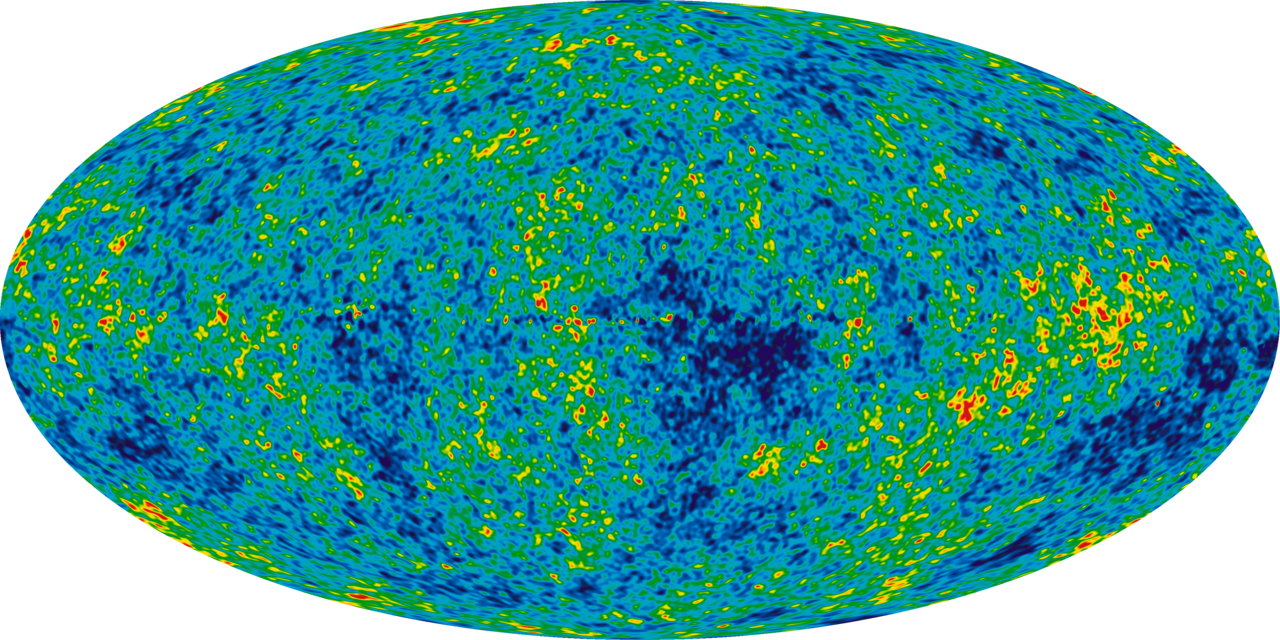
“The density fluctuations in the cosmic microwave background (CMB) provide the seeds for modern cosmic structure to form, including stars, galaxies, clusters of galaxies, filaments, and large-scale cosmic voids. But the CMB itself cannot be seen until the Universe forms neutral atoms out of its ions and electrons, which takes hundreds of thousands of years, and the stars won’t form for even longer: 50-to-100 million years.” (BigThink. The strongest evidence for a Universe before the Big Bang)


“Regions of space that are slightly denser than average will create larger gravitational potential wells to climb out of, meaning the light arising from those regions appears colder by the time it arrives at our eyes. Vice versa, underdense regions will look like hot spots, while regions with perfectly average density will have perfectly average temperatures.” (BigThink. The strongest evidence for a Universe before the Big Bang)


“The quantum fluctuations that occur during inflation do indeed get stretched across the Universe, and later, smaller-scale fluctuations get superimposed atop the older, larger-scale ones. These field fluctuations cause density imperfections in the early Universe, which then lead to the temperature fluctuations we measure in the cosmic microwave background, after all the interactions between dark matter, normal matter, and radiation occur prior to the formation of the first stable, neutral atoms.” (BigThink. The strongest evidence for a Universe before the Big Bang)


“The quantum fluctuations inherent to space, stretched across the Universe during cosmic inflation, gave rise to the density fluctuations imprinted in the cosmic microwave background, which in turn gave rise to the stars, galaxies, and other large-scale structures in the Universe today. This is the best picture we have of how the entire Universe behaves, where inflation precedes and sets up the Big Bang. Unfortunately, we can only access the information contained inside our cosmic horizon, which is all part of the same fraction of one region where inflation ended some 13.8 billion years ago.” (BigThink. The strongest evidence for a Universe before the Big Bang)


“If you look farther and farther away, you also look farther and farther into the past. If the number of galaxies, the densities and properties of those galaxies, and other cosmic properties like the temperature and expansion rate of the Universe didn’t appear to change, you’d have evidence of a Universe that was constant in time; that is not what we see.” (BigThink, Even before the Big Bang, space wasn’t truly empty)

Where there were no other electromagnetic fields. Electrons were just formed. The suggestion of how those fields formed, or which was the formation order of those fields, is that first were strong nuclear interaction fields, because those fields are radiation or wave movement that formed in the quark gluon plasma. Those high-energy particles condensed from the whirls in the gravity field. Then we must remember. Electromagnetic fields form in electron interactions. The weak nuclear interaction forms between protons and neutrons. That model mean. Electromagnetic fields formed before the weak nuclear interaction, because the weak nuclear interaction requires baryons that can form only if quarks can form protons and neutrons.  


So the four fundamental forces formed in the next order. 


1) Gravity


2) Strong nuclear interaction


3) Electromagnetism


4) Weak nuclear interaction. 


When we talk. About the force formation. We talk about. The situation, the environment, and the force that. Takes the form that makes their interaction possible. 

That means energy that existed before the Big Bang formed the universe. But where does that energy or wave movement come from? The logical explanation can be. The origin of that field or gravity waves could be another universe. The existence of other universes is logically possible. That model mean. That universes form structures like galaxies and galaxy clusters. But if we observe those kinds of theorems. We face one reality. If another universe exists and some particle travels between that universe and our universe, that hypothetical particle must travel through an extremely low-energy space. This means that there is no energy that can press the quantum field. 

That particle evaporates or turns into a wave movement. This would happen. Even if our universe were alone. This means that the dark energy’s origin can be in the space outside the universe. When a particle turns into a wave movement, it sends an energy impulse around it. Or it releases energy that condensed into that particle. This energy travels back to the universe. In the same way, a black hole that travels  out of the universe detonates. Every day, particles flow out from the universe, and that means there can be multiple energy sources outside the universe. If energy travels out from another universe, that low-energy spacetime will stretch that wave so long that it's hard or even impossible to detect. 

But then back to the Big Bang. The question is, where does the first universe get its existence? That is the question that makes the multiverse theory quite hard to control. Where did the first universe get the wave movement that formed it?


https://bigthink.com/starts-with-a-bang/evidence-universe-before-big-bang/


https://bigthink.com/starts-with-a-bang/universe-wasnt-empty-before-big-bang/


https://scitechdaily.com/universes-first-magnetic-fields-were-as-weak-as-human-brain-waves/


Friday, July 18, 2025

Time, gravity, and photons.


"A representation of the evolution of the universe over 13.77 billion years. The far left depicts the earliest moment we can now probe, when a period of "inflation" produced a burst of exponential growth in the universe. (Size is depicted by the vertical extent of the grid in this graphic.) For the next several billion years, the expansion of the universe gradually slowed down as the matter in the universe pulled on itself via gravity. More recently, the expansion has begun to speed up again as the repulsive effects of dark energy have come to dominate the expansion of the universe." (NASA, Universe Expansion Funnel)


When people say that time stops in photons, they mean that a photon delivers as much energy as it gets. So the photon itself has no time. But a photon's time is bound with the universe. This means that the age of photons is connected with the universe’s existence. 

The thing is that in the young universe, energy levels and scattering effects were stronger than in the modern universe or the universe where we live. The speed of light is a cosmic constant that depends on the environment. The speed of light is higher outside the atmosphere than in water or gas. 

The distance of particles and energy level, which means the power of the radiation, determines the speed of light. And the photon's speed is always the top. Because the speed of light always increases because of the weaker quantum fields and growing distance between particles, that means the photon's speed accelerates. And then we must understand that the other particles' speed compared to the photon’s speed is the same as in the past. When the entirety’s speed rises, the speed between objects seems the same. 

When we think about claiming that the universe expands faster than light, we can say yes and no. The fact is that the speed of light in the modern universe is higher than in the young universe. So there is a possibility that in the modern universe particles can travel faster than photons traveled in the young universe. But still, those other particles’ speed is lower than the photon's speed. The expansion of the universe causes light to travel faster. But because all other particles also travel faster than that, it is hard to see. 

"An illustration (not to scale) of a primordial black hole growing to supermassive size. (Image credit: Robert Lea (created with Canva))" (Space, Tiny ‘primordial’ black holes created in the Big Bang may have rapidly grown to supermassive sizes)

The other point is that. When a photon travels out from the universe, its speed should increase. But then the gravity of the entire universe pulls the photon back. It's hard to determine how fast a photon travels outside the universe. When a photon travels outside the universe, that means the universe pulls a photon into it with its entire mass. If the photon is in the universe, there is less mass behind it than outside the universe. 

In the same way, when we are at the edge of planet Uranus’s atmosphere, the gravity seems very strong. But when we drop to the surface of the stone shell or lithosphere of that planet, we face a situation where gravity is weaker than on Earth. The same way the universe can act when something is outside it. 

 When a black hole is behind a photon, that thing pulls the photon back to it. The massive gravitational effect also pulls the wave movement longer. This means that there is a possibility that the universe would be quite hard to see outside. But that is only speculation. 

The oversized black holes can form from tiny primordial black holes in the young universe. In the young universe, those black holes were closer to each other. And that caused a situation in which they collide more often than in the modern universe. 

When we think about enormous black holes in the young universe, we must realize that those black holes formed in conditions where the energy level was higher than in the modern universe. That means energy, or quantum fields, press against a black hole more powerfully than in the modern universe. That allowed the black holes to grow to an enormous size. Those black holes could form in a whirl in the powerful radiation. And when the universe expands, maybe those black holes' event horizons grow.

When the quantum fields turn weaker, that means the black hole starts to send radiation. That radiation can cause gravitational waves. The expansion of the universe can be one of the reasons why black holes sometimes separate from their material disks. And that causes the gravitational wave bursts. The expansion of the universe causes energy to move throughout the universe. And that thing is one of the things that causes the effect called time.


https://www.cfa.harvard.edu/news/over-massive-black-hole-young-universe


https://www.iflscience.com/are-those-eerie-oversized-black-holes-in-the-early-universe-the-result-of-direct-collapse-74341


https://svs.gsfc.nasa.gov/12314


https://www.space.com/astronomy/black-holes/tiny-primordial-black-holes-created-in-the-big-bang-may-have-rapidly-grown-to-supermassive-sizes


Friday, January 27, 2023

Gravitational waves or ripples in spacetime could point to the place of the Big Bang.


The point where the Big Bang happened should be in the middle of the universe. But the fact is that is the exact point. Where the Big Bang happened could also be moved. Or the universe around that point is moved asymmetrically. The idea is that some remnant of the Big Bang is a supermassive black hole. 

And that remnant involves information about the Big Bang itself. But the problem is that we should find the first black hole that formed just after the Big Bang. That is a very difficult thing to do in real life. All black holes look similar. 

So researchers should find the right black hole. And then they could listen to the echoes from the universe's first moments. The thing is that the first gravitational waves. That left from the Big Bang traveling the outside the edge of the universe. The shockwave that formed in the Big Bang can call, as the "edge of the universe". When we are thinking about the form of the most outpoint of the universe there should be a small density to another point in the universe. 

Because the front of the material is traveling the shockwave there is a gravitational wave. That thing makes the edge of the universe a little bit thicker than the material behind that wave. But there is the possibility that we could see the remnant of the Big Bang by using another method.  There is a possibility. 

That the same part of the radiation that the source is in the Big Bang jumps inside the universe. Black holes can turn the direction of gravitational waves. But there is a possibility that the black holes were far behind the gravitational waves. and even if gravitational radiation jumps between black holes we should have some method to separate those gravitational waves from disturbing gravitational waves, that are released later. The problem with this kind of research. is how to find the right gravitational waves. 


https://artificialintelligenceandindividuals.blogspot.com/

Sunday, January 22, 2023

The gravitational waves can bring us back to the point where everything began.


Gravitational waves are a new tool for researching the universe astronomers observe the most distant objects. To find things that happened a long time ago. 

Gravitational waves can tell about things that happen behind a black hole's event horizons, but they can also use to detect black holes.  If a black hole's transition disk is weak. 

Or if its distance is very long. It's possible that X- and Gamma ray radiation. That comes from the black hole disappearing in X- and Gamma-ray background. 

Galaxy GN-z11 is the most distant galaxy that we ever saw in history. The distance to that galaxy is 38 billion light years. So we see what happened in that galaxy 38 billion years ago. 

The reason why researchers are observing extremely distant galaxies is that particles that are traveling across the universe are taking plague to their core. That plague involves information about the universe that the particle touched. 

Another reason that those distant galaxies can uncover is the place. Where the Big Bang happened. There is a possibility that at that point is the black hole that stored the information about the Big Bang.  If that hypothetical supermassive black hole in the center of the universe is real. This thing would be the biggest event in the history of cosmology, 

But even the most distant galaxies will not help us to see the event called the Big Bang. The reason for that is simple. Those galaxies formed after the Big Bang. 

But can we find the Big Bang? Or can we get information about that event? There is one little possibility to see the photons or something. That are remnants of the Big Bang. 

The theory of the Big Bang goes like this. All visible material and energy in the universe are released in this event. 

Theoretically, it is possible. That part of that material and energy formed a black hole. If researchers can find the first black hole. There could be stored photons that involve information about the Big Bang. 

The idea of this hypothesis is that the black hole can trap some photons at the point of the event horizon. The time is not moving at that point. So black holes can store information from the Big Bang. But there is one requirement. The black hole must be formed during the Big Bang. Otherwise, it cannot trap the right photons. 

When we think about the first photons or information that Big Bang released we cannot see that information because that information travels away from us. The problem with photons is that we cannot see them from backward. We can see photon that travels to us.

But we cannot see photons. That travels in the opposite direction to us. Or we cannot see photon that travels ahead of us. There is a possibility that we can see the photons that are stored in the event horizon of the black hole. The gravitational waves of extremely old black holes can tell many things about the chaotic young universe. 

When the universe was very young and hot it was a chaotic mixture of photons, electrons, and other elementary particles. Then there was formed the central. That central could be a black hole that formed. The first whirl in the chaotic universe in which the temperature was extremely high. The whirl created the sub-whirls in the chaotic quantum-gluon plasma. And maybe those whirls formed material. 


https://scitechdaily.com/revealing-the-start-of-time-itself-ripples-in-the-fabric-of-the-universe-may-peer-back-to-the-beginning-of-everything-we-know/


https://en.wikipedia.org/wiki/GN-z11


https://astronomyandtechnology.blogspot.com/

Friday, January 6, 2023

The universe expands, but the expansion rate is not accelerating.


The acceleration speed of the universe is constant Between 45 and 50 km/s/Mpc. The speed of acceleration doesn't increase. And that is interesting. Because when an object's distance increases gravitational interaction between them turns weaker. And that means the acceleration speed should increase. 

So what does this mean? Is in the middle of the universe some kind of dominating gravitational effect, like an extremely large black hole? Or some yet unknown gravitational effect that stays at a stable distance from galaxies. And that causes a question: is there some kind of yet unknown layer inside the universe? 

There is another interesting detail about the speed of light in the universe. The speed of light is the cosmic constant that is stable in a vacuum. But different mediums are affecting that speed. So if light travels through some structures, it slows light. So could there be some kind of structure that causes errors in redshift? 

But one of the most interesting questions in the universe is where all its material is gone. Today universe has much fewer atoms than in the young universe. There was no dark energy at all in 380 000 years old universe. So where does dark energy come from? This is one of the most interesting questions in cosmology. 

If we think that quantum vaporization is the reason that dark energy or free energy started to affect and dominate the system. We must also understand that energy doesn't come from anything. 

If we think that dark energy is the result of hypothetical dark matter particles turning to wave motion we can think that dark matter and visible matter both have cosmic inflation. But does cosmic inflation affect differently to dark matter and visible matter? Or does cosmic inflation time different in dark matter and dark energy? 


The Big Bang is normally oversimplified. The Big Bang is the event or series of events where the universe began. 


Cosmic expansion is an interesting thing. If we think that all material in the universe came from a single point called the Big Bang we are oversimplifying that effect. If the Schwinger effect formed the universe it could form two universes our universe and the antiuniverse. In the antiuniverse, time goes like in our universe. But the difference between those universes is that in antiuniverse protons are negative. And electrons are positive. 

So the real name for the hypothetical antiuniverse is the antimaterial universe. The reason why somebody believes that thing is in Schwinger effect. When crossing wave movement turns to particles, the Schwinger-effect forms particle-antiparticle pair. If the energy level of that effect is high enough it pushes those particles and their anti-particle pairs so far away that they are not returning together. 

If those particle-antiparticle pairs touch each other the result is annihilation. Those particles and their anti-particle pairs turn back to radiation. So, were there some yet unknown particles in the young universe that do not exist anymore? When we think about the form of the Big Bang, we must realize that the biggest question is where all material of that event came from. If the universe's origin was the Schwinger effect, there must be some origin for the wave motion. 


https://bigthink.com/starts-with-a-bang/universe-expansion-not-accelerating/


https://plancksatellite.org.uk/science/timeline/


https://en.wikipedia.org/wiki/Schwinger_effect


https://artificialintelligenceandindividuals.blogspot.com/

Monday, December 19, 2022

The hollow universe model.


"In some models, dark energy is only the wave motion that travels faster than it should. An idea of this model is that the universe speed of light is not the same in the entire universe. And that thing forms the effect called "dark energy". "

The geometrical shape of the universe is a thing that determines the ultimate fate of the universe. The problem with determining or finding out the universe's geometrical shape is that we can see only a small part of the universe. Most of the material is in the form of dark matter. Dark matter determines the shape of the universe. 

Those possible shapes are spherical, hyperbolic, and flat universe. If the universe's shape is spherical gravitation will win. And the universe collapses in Big Crunch. Otherwise, the universe continues its expansion forever. 


The idea is that the spherical universe is hollow like all other universes. And the Big Bang pushed all material away from it forming a pressure wave. That pressure wave consists of all material that we know. If the universe is flat that theory introduces the universe as the form of a compact disk-shaped structure. If the universe's shape is spherical that thing means that material is forming a ball there is a hole in it. 

The weakness of those models is that they handle the universe as a 2D structure. The universe is a 3D structure that is in the 3D universe. But in the most interesting models, there is a hole in the middle of the material. That can be a ring-shaped or hollow ball or layer where is a hole. That hole also works with the parabolic universe. 


"The local geometry of the universe is determined by whether the density parameter Ω is greater than, less than, or equal to 1. From top to bottom: a spherical universe with Ω > 1, a hyperbolic universe with Ω < 1, and a flat universe with Ω = 1. These depictions of two-dimensional surfaces are merely easily visualizable analogs to the 3-dimensional structure of (local) space." (Wikipedia/Shape of the universe)


In that model, the energy level in that hole is lower than in other places of the universe. But that hole's energy level is higher than the energy level of the space where the universe hovers. And that causes the situation where energy from the universe travels outside the universe. But energy also travels in the hole of the universe. In that hole wave motion impacts together and forms a situation where the energy level of that area rises.

Because the energy level of the hole is higher than the energy level outside the system. That causes the bottom flow where energy travels from the hole to outside the universe. And that thing means that the energy that comes inside the universe blows the material ring outside. So the energy that travels out from the hole is the free energy that rips the universe into pieces. And the name of that free energy is dark energy because nobody has seen the origin of that mysterious wave motion. 


There is the possibility that the universe looks like the Kuiper belt. But it's far more massive and larger than this structure. That surrounds the solar system. 

But there is a possibility that there is a hole in the universe. 


The idea of this model comes from the idea that the Big Bang formed a shockwave. That is similar to the ring that forms when a hydrogen bomb explodes. That ring is visible in image 2, which portrays the thermonuclear detonation in the Pacific Ocean in the 1950s. 

So the material in the universe is in the mega- tera-structure that looks like Saturn's rings or Kuiper belt which is a ball-shaped asteroid and dust structure that surrounds our solar system. There is a possibility that the visible material is forming the ring-shaped structure in the ball-shaped entirety that is formed of dark matter. 

That thing means that the Big Bang formed the material that travels across the universe like the ring-shaped shockwave that forms when a hydrogen bomb or supernova explodes. And if the universe's shape is some kind of wheel or hollow ball. That thing could explain the dark energy in a very fascinating way. 


Image 3: Model of the hollow universe


1) Hole

2) Material ring where all known material exists. 

3) Space where the universe hovers. 


"Chart shows the proportion of different components of the universe  – about 95% is dark matter and dark energy." (Wikipedia/Big Bang)


How does this model explain dark energy? 


In this model inside, the donut-shaped or hollow spherical universe is the hole where the energy level is lower than in the material ring that surrounds that hole. The energy level in that hole is higher than the energy level of the ring-shaped (or ball-shaped) universe's outer edge. 

So energy travels in both sides of the ring where all material that we know exists. But then in the middle of that ring is a higher energy level than outside the system. And that makes the bottom flow, which makes the energy travel across the universe. From inside to outside that thing. And that energy flow will push the universe larger. So that thing makes cosmic inflation possible. 


https://solarsystem.nasa.gov/solar-system/kuiper-belt/overview/


https://en.wikipedia.org/wiki/Dark_energy


https://en.wikipedia.org/wiki/Dark_matter


https://en.wikipedia.org/wiki/Shape_of_the_universe


https://en.wikipedia.org/wiki/Ultimate_fate_of_the_universe


Could there have been UFOs in Earth's orbit in the 1950s?

Aligned, Multiple-Transient Events in the First Palomar Sky Survey could be artificial objects. Or. They could also be some light reflection...