Showing posts with label black hole. Show all posts

Friday, July 10, 2026

Simulations confirm. The black hole can evaporate.


“The one thing we all 'know' about black holes is that nothing escapes their ineluctable grasp. That is mostly true, but since the 1970s, physicists have predicted that black holes could slowly lose energy. In the form of thermal radiation. This is Hawking radiation, and while it has been recreated in laboratory analogs, the mechanism whereby it siphons energy from a black hole, known as backreaction, has remained elusive. Now, in a black hole analog made of – ironically – light, a team of physicists led by Lorenzo Procopio of Paderborn University in Germany has observed. An analog of Hawking radiation backreaction.” (ScienceAlert, Physicists Simulated a Black Hole in a Lab. Then It Started to 'Evaporate'.)

A photon can steal energy just from the event horizon. The point where the escape velocity reaches the speed of light. Not inside it. So this means that Hawking radiation. It can come from the “surface” of the event horizon. Or maybe those photons make a small hole. Into that event horizon. And the big question is: could Hawking radiation be the dark energy? This means that the hypothetical WIMPs (Weakly Interacting Massive Particles). That could form dark matter. That can be the source of the dark energy. This model suggests that impacting WIMPs are the source of the dark energy. 

New simulations confirm black hole evaporation. That observation tells us that the material disk around a black hole plays a very important role in a black hole’s existence. Today reseachers suggest that nothing can escape from a black hole. But new simulations tell us that the Hawking radiation can be real. It is possible that Hawking radiation forms as a photon travels through the event horizon. Short moment. The photon is on both sides of the event horizon. And that means it can send another photon. If the photon’s energy level is lower than in and out of the event horizon. The low-energy photon can absorb energy. This is one vision of how the Hawking radiation can form. The black hole interacts like a cold object. The reason for that is in the spin. Fast-spinning ultra-degenerate material. 

That can bind quantum fields from around it. As long as the energy level in the black hole’s singularity is lower than outside. That means outside energy keeps the black hole in its form. The ultra-fast spin binds energy from around it. The spinning singularity binds energy. Until the energy level in its plasma halo or transition disks. Turns out to be lower energy than the energy level. In the event horizon is. When a black hole’s energy level grows. And its spin accelerates. It requires more and more energy to keep information inside it. 

This means that. The material disk around the black hole turns larger. This process accelerates the singularity. But if someday it happens that. The spin on the black hole’s singularity decreases. That singularity delivers energy. And that process can explain evaporation. When the speed of the black hole’s spin slows. It delivers wave movement. And that can cause Hawking radiation. And the evaporation of the black hole. The low-energy photon that touches the event horizon. The point. The black hole’s escaping velocity reaches the speed of light. That photon can steal energy.


"The accretion disk of NGC 4151 is shown blue, immediately surrounding the galaxy’s central black hole. Scientists, including University of Michigan astronomers, are showing how winds or outflows from the accretion disk reshape its host galaxy. The winds are shown as wispy light blue lines blowing across the more orange clouds surrounding the black hole. Credit: JAXA" (ScitechDaily, XRISM Reveals Galaxy-Shaping Winds Erupting From a Supermassive Black Hole)

Not from inside the black hole. From the black hole’s event horizon. The point where the escaping velocity reaches the speed of light is clear and sharp. And if a low-energy photon reaches that point. The photon can form a small tunnel between it and even the horizon. The photon steals energy just from the point of the event horizon. This means that the low-energy photons. They form small waves in that event horizon. 

The black hole itself is invisible. But we can see them through their interaction. The material disks around them are very high-energy objects. Black holes pack material around them. So that means there could also be other high-mass black holes near the Milky Way’s center. Because calculations don’t match reality. That means there are some unknown objects and components in that region. One of the components that can cause problems in the fit calculations. And observations together. That is the dark matter. Dark matter that interacts through gravitation. It can also form.  An invisible matter disk.  Around the black hole. That invisible disk might not follow the form of a visible matter disk. 

Dark matter can form an invisible matter disk around a black hole. We don’t see the black hole itself. We see it's a matter of an acceleration disk. When the speed of that matter rises. And high-energy radiation hits that matter. Its energy level and weight rise. That can cause a situation. There, the calculations and observations don’t match. When the particle changes its direction. It sends light quanta. This means. The outer edge of the matter disk should send some kind of radiation. If dark matter behaves like visible matter. That invisible material disk. That dark matter forms around the black hole. It can send wave movement like visible matter. This supports the model that dark energy could form. In the mutual interaction of dark matter particles. 

In some models, the black hole. It can also pull only dark matter inside it. If that can happen, the black hole would be invisible. The thing that determines whether this hypothesis is true or false.  Is it the strange gamma-ray glow? There is a possibility that dense-packed dark matter. It can form a gamma-ray. That gamma-ray glow. It can come straight from those hypothetical dark matter particles. Or it could be emission radiation. When those hypothetical dark matter particles. They pack densely enough. And impact often enough with the visible matter particles. That can form the gamma-ray glow. 

Black holes are ultra-massive objects. But they are gravity centers. This means that black holes. They have static orbiter trajectories. That causes an effect. That the black holes might have planets. But the supermassive black hole is in the center of the galaxy. Sagittarius A. Or Sgr*A will not pull all dust inside it. Some part of the dust around Sgr* A. It could orbit it in a static trajectory. That is one of the interesting details about Sgr A and all other black holes. 

This means that. The center of the Milky Way is far more complicated. Then, just as in a region, there are black holes that pull matter inside them. And rip everything in pieces. This means that there are whirls where particles impact. In the same way, eruptions in Sgr*A can cause energy flow in the material. And that increases entropy. 

The glow of black hole formation happens. In its material disks. The entropy causes friction. That makes that disk glow. Quantum fields travel into black holes a little bit faster. Than. Particles travel in that disk. This causes a situation. There, the field transports energy. Into the material. This causes a glow in the black hole’s material disk. Entropy in the material disk causes the glow. This means that if the black hole could pull material inside it. Without forming that disk. 

The black hole would be invisible. But that case is impossible. All matter and wave motion. Which travels into the black hole follows the spiral trajectory. The reason for that. All particles travel into the black hole from different angles. That thing causes whirls. Those whirls. They form friction that causes particles to glow. Another thing. That can make a black hole invisible. That is a brighter gamma- and X-ray source than the black hole. If the black hole is in an extremely.  High energy area. Its material disk and its glow. Hide under the brighter entirety. 


https://www.open.ac.uk/blogs/news/science-mct/space/astronomers-think-theyve-just-spotted-an-invisible-black-hole-for-the-first-time/


https://www.sciencealert.com/physicists-simulated-a-black-hole-in-a-lab-then-it-started-to-evaporate


https://www.sciencealert.com/something-far-darker-than-a-black-hole-could-hide-in-the-heart-of-the-milky-way


https://scitechdaily.com/the-milky-ways-black-hole-isnt-tearing-everything-apart-new-observations-reveal-a-surprise/


https://scitechdaily.com/the-milky-ways-mysterious-glow-may-be-dark-matter-after-all/


https://scitechdaily.com/xrism-reveals-galaxy-shaping-winds-erupting-from-a-supermassive-black-hole/


https://en.wikipedia.org/wiki/Dark_energy


https://en.wikipedia.org/wiki/Dark_matter


https://en.wikipedia.org/wiki/Hawking_radiation


https://en.wikipedia.org/wiki/Weakly_interacting_massive_particle

Tuesday, March 17, 2026

The neutron star followed an oval trajectory before it collided with a black hole.


“Artist’s impression of an eccentric neutron star–black hole binary. The neutron star’s path is shown in blue and the black hole’s motion in orange as the two objects orbit each other. The eccentricity shown here is exaggerated compared to the real system, GW200105, to make the effect on the orbital motion clearer. Credit: Geraint Pratten, Royal Society University Research Fellow, University of Birmingham” (ScitechDaily, Scientists Spot a Black Hole-Neutron Star Pair Breaking the Rules of Cosmic Orbits)

The neutron star’s unusual trajectory when it fell into a black hole. The thing that formed that unusual oval trajectory could be the third component. There could be a possibility. That there was something unseen. Maybe the second back hole in the system before the final impact. The third participant can be outside the system. Or maybe it's very close to the back hole. 

The neutron star and black hole collided, and this thing defies predicted models. The neutron star impacted the black hole following an oval trajectory. This means that the closest point in that trajectory moved closer and closer to the black hole. And then the black hole pulled that neutron star inside it. The reason for that trajectory is that the neutron star got more energy when it closed the black hole. 

Similarly, in cases where black holes merge with neutron stars, they also have their own material disk. The impact of material disks will create energy, which pushes the neutron star away from the black hole. This also explains gamma-rays. From those mergers. 

The material disk interacts with the black hole material disk, and that forms energy. So this means that the shape of the trajectory remains similar. But sooner or later, the black hole “steals” the neutron star’s material disk. This means that the neutron star will not get as much energy from the impact of those material disks. This means that the black hole pulls the neutron star closer and closer to it. 


https://scitechdaily.com/scientists-spot-a-black-hole-neutron-star-pair-breaking-the-rules-of-cosmic-orbits/


Monday, December 8, 2025

The electromagnetic interaction can slow black holes.


Plasma around a black hole sends powerful radiation. That radiation causes effects, and the black hole also pushes objects from around it. It’s not only gravitation. That pulls objects to the black hole. Also, things like electrons and protons that impact objects have an effect on objects. When gravity alone pulls objects, it is not the same. As the gravitation. And electromagnetic interactions together pull objects like electrons. 

Maybe electromagnetic interaction itself cannot slow a black hole. But the electromagnetic interaction can slow plasma whirl. Around a black hole. Or the electromagnetic interaction can pull plasma away from the black hole. That decreases the energy that travels in that object. When a small object like an electron falls into a black hole. It’s possible. That just before it hits the event horizon. The electron transmits energy. 

Out of the black hole. The top point of the electron is on a lower energy level. Than the bottom of it. That causes a situation. Where energy travels to the top of the electron. That forms a small high-energy object at its axle. And that pushes the electron forward. Normally, those things mean almost nothing. But in a black hole’s extremely dense conditions, even a small thing. Means very much. 

The interaction between magnetic fields and black holes is one of the least researched phenomena in the universe. The interaction means that the magnetic field can slow down. The rotation of a black hole. The rotation of a black hole slows when the magnetic field accelerates or slows. Plasma whirls around the black hole. When that whirl accelerates. It converts kinetic energy into it. When the speed of that whirl slows, it releases its kinetic energy. 


"A still image from a computer simulation of a black hole’s formation and evolution. Credit: Ore Gottleib/Simons Foundation" (ScitechDaily, Scientists Finally Explain Mysterious “Impossible” Merger of Two Massive Black Holes)


"An infographic describing the new work. Credit: Lucy Reading-Ikkanda/Simons Foundation". (ScitechDaily, Scientists Finally Explain Mysterious “Impossible” Merger of Two Massive Black Holes)


When plasma starts to whirl near a black hole’s event horizon, its energy level rises. And that means they bring more energy to the black hole. The mass of those particles is far higher than outside the whirl. And when the magnetic field pulls those particles backward. That effect also affects the black hole’s gravitational field. It slows the black hole’s rotation speed. 

A black hole takes its energy from the whirl. Around it. The black hole binds energy from that whirl. Into it. And transforms it into kinetic energy. When the speed of the whirl slows, it transfers less energy to the black hole. The black hole is massive. But it's still in interaction with its environment. The heavy mass can also slow down. The speed of the black hole. 


"These 3D renderings of a direct-horizon collapsar with an initially weak magnetic field illustrate the system’s evolution. Early in the collapse, accretion disk winds unbind much of the stellar envelope, reducing the mass available for accretion onto the black hole. Eventually, a one-sided jet emerges from the region just outside the black hole, spinning down the black hole and expelling the remaining stellar material. Credit: Ore Gottleib/Simons Foundation" (ScitechDaily, Scientists Finally Explain Mysterious “Impossible” Merger of Two Massive Black Holes)


“Inferred orbits of 6 stars around the supermassive black hole Sagittarius A* at the Milky Way's center”. (Wikipedia, Sagittarius A* cluster)


When a black hole slows, it must realease its energy. And in that moment, it sends gamma or gravitational waves. Many times. Black holes are mentioned as the extreme gravitational objects. In those cases, the interactions are simplified. Black hole’s halo. And its relativistic jets are the highest-energy phenomena. In the universe. That plasma-halo. Also transmits energy out from the black hole. This means that. The black holes are, anyway. A little bit like other stars. 

In modern research, black holes are not as devastating as researchers believed. Research about the Sagittarius A*, (Sgr* A) the supermassive black hole in the center of the milky way gives an information that there are also objects in stable trajectories around the Sgr*A. Many of those objects are very hot stars. That means those stars can probably push material from around them. That causes the effect. That's the matter. That which falls into the black hole cannot affect the star. When an object falls. To a black hole, gravity pulls fields that make objects travel with it. But also things. Like gas and other particles push those objects into the black hole. 

The plasma whirls around the black hole, acting like a generator. That forms an extremely powerful magnetic field. And when a black hole pushes and pulls matter. All its wave interactions and plasma interactions affect objects around it. Things like gamma-ray and X-ray radiation are high-energy short-wave radiation that tunnels through the plasma. Also, things like neutrinos can tunnel through those fields and other objects. 


https://www.aanda.org/articles/aa/abs/2024/10/aa50571-24/aa50571-24.html


https://scitechdaily.com/scientists-finally-explain-mysterious-impossible-merger-of-two-massive-black-holes/


https://en.wikipedia.org/wiki/Sagittarius_A*


https://en.wikipedia.org/wiki/Sagittarius_A*_cluster

Sunday, August 17, 2025

Black Holes, Dark Matter, and Information.

    Black Holes, Dark Matter, and Information. 


"Artist’s conception of a supermassive black hole, billions of times more massive than the sun, like those found at the centers of galaxies. The black hole’s rapid spin and powerful magnetic fields can launch enormous jets of plasma into space, a process that could potentially generate the same results as human-made supercolliders. Credit: Roberto Molar Candanosa/Johns Hopkins University" (ScitechDaily, Scientists Eye Black Holes as Cosmic Supercolliders in the Hunt for Dark Matter)

At the beginning of time, before our universe, only a G-field, or gravitational field, existed. Then, there formed some kind of whirls in that G-field. Those hypothetical whirls were gravitons. The idea is that the hypothetical graviton particle is a stick-shaped structure, a particle that forms from the quantum field. 

The form of the hypothetical graviton particle could be like tornado. So are the graviton and another hypothetical particle, axion the same thing? The idea is that we cannot see axions because their spin is so fast that it creates fields around them in the shape that looks a little bit like a black hole. 

The idea is that the graviton is so smooth that it cannot take outside fields inside it. And then it starts to transport those fields into its spin axle. So could that thing also explain dark energy? Graviton pulls energy from around it. That particle binds that energy inside in the form of kinetic energy and then aims it to the spin axle. That particle looks like a black hole. The particle collects energy until its energy level turns so high that energy can start to travel outside the particle or quantum field that surrounds it. 

When the mass or kinetic energy of a particle grows, it pulls material and quantum fields from larger areas into it. That thing locks black holes into their form. If that whirl vanishes black hole erupts immediately. That whirl denies the energy escaping from the particle’s or objects' equator. And that is the thing that creates the black hole’s relativistic jet. 

Black holes pull information inside them. Or if we think carefully, black hole rolls information from its environment around its spin axle. That means there is possibility to release that information. There is a question of whether information exists without a physical form. So if we think that information is wave movement, we must ask can information travel without superstrings or does it need superstring for existence. Information will be stored in quantum fields and particles as in curves. That should not be erased even in black holes. Those curves, or “mountains” and “valleys” can turn so low that they are hard to detect. 

But theoretically is possible to restore, or recalculate information that black hole stored. When black hole pulls quantum field, and information that quantum field carries inside it, we can think that the process is similar when something rolls paper around axle. The paper forms the roll, and it's possible to roll that paper from the axle. This is the thing. That makes the black hole collisions interesting. There is a possibility that during those events, the black hole can pull information out from another black hole. And possible somday we could decode that information. 

Researchers uncovered a hidden symphony in a black hole hidden vibrations. And that might help them to read information. That the black hole stored. 


"Black holes don’t just warp space, they sing. And now, for the first time, we’ve figured out what their cosmic echoes really sound like. Credit: Shutterstock" (ScitechDaily, Scientists Uncover the Spiraling Symphony Hidden in Black Hole Vibrations)


Another interesting thing in the universe are very old, large black holes. The biggest black holes formed in the early universe. Those monsters lost their mass after that. The reason for this is the expansion of the universe. Or, otherwise, weakening quantum fields and decreasing the number of particles. This thing tells. The universe expands. Or does it? There is another explanation for that thing. This very radical theory goes like this: the black hole is a more common phenomenon in the universe than we expected. And the black holes that are “sleeping” simply pull particles and quantum fields inside them. If those black holes exist between galaxies, they are very hard to detect. 

If all electromagnetic fields and particles are formed after the Big Bang, or the beginning of the universe, that means that when black holes pull those fields and particles inside them, there are fewer particles and fields left in the universe. So, can we see that effect as an expansion of the universe? There is a possibility that only the G-field existed before the Big Bang. And that field formed all other quantum fields. But we know that black holes are massive objects. There are black holes between galaxies. And black holes can collact particles to around them. 

That means that the dark matter should interact with black holes. And maybe that thing helps to find things like axions. Axions are hypothetical dark matter particles. Sometimes is introduced that axions are particles that spin very fast. That thing means that the axion can be like a stick or some kind of rugby ball. So, that means that. Maybe near black holes, regular particles could turn into axions. When a particle's spin accelerates, it binds energy into it in the form of kinetic energy. During that process, the outside quantum fields travel to that particle. 

And press it into a smaller size. If we think that particle is a whisk-shaped superstring stucture when outcoming quantum field pushes particle into a smaller size, those superstrings turn closer to each other. If those superstrings turn close enough to each oher. That turns the particle very smooth. And that means the quantum fields travel around the particle. The quantum fields that travel to the particle’s poles will start to travel out from the particle along its spin axis. That thing means that the particle starts stretching. 

And then it starts to transport the quantum field out from its spin axle. If some stick-shaped, fast-spinning particles form black holes, that means that the black hole will not pull things inside it. It just accelerates and aims fields form around it. That thing explains the black hole relativistic jet. That causes the idea. That maybe hypothetical gravitons are axions. Maybe. The graviton is like a tornado in the G-field.  As I wrote at the beginning of this text. 


https://scitechdaily.com/mysterious-radio-signals-reveal-whats-hiding-between-galaxies/


https://scitechdaily.com/scientists-eye-black-holes-as-cosmic-supercolliders-in-the-hunt-for-dark-matter/

https://scitechdaily.com/scientists-uncover-the-spiraling-symphony-hidden-in-black-hole-vibrations/


https://scitechdaily.com/webb-telescope-spots-oldest-black-hole-shattering-cosmic-records/


Friday, July 18, 2025

Time, gravity, and photons.


"A representation of the evolution of the universe over 13.77 billion years. The far left depicts the earliest moment we can now probe, when a period of "inflation" produced a burst of exponential growth in the universe. (Size is depicted by the vertical extent of the grid in this graphic.) For the next several billion years, the expansion of the universe gradually slowed down as the matter in the universe pulled on itself via gravity. More recently, the expansion has begun to speed up again as the repulsive effects of dark energy have come to dominate the expansion of the universe." (NASA, Universe Expansion Funnel)


When people say that time stops in photons, they mean that a photon delivers as much energy as it gets. So the photon itself has no time. But a photon's time is bound with the universe. This means that the age of photons is connected with the universe’s existence. 

The thing is that in the young universe, energy levels and scattering effects were stronger than in the modern universe or the universe where we live. The speed of light is a cosmic constant that depends on the environment. The speed of light is higher outside the atmosphere than in water or gas. 

The distance of particles and energy level, which means the power of the radiation, determines the speed of light. And the photon's speed is always the top. Because the speed of light always increases because of the weaker quantum fields and growing distance between particles, that means the photon's speed accelerates. And then we must understand that the other particles' speed compared to the photon’s speed is the same as in the past. When the entirety’s speed rises, the speed between objects seems the same. 

When we think about claiming that the universe expands faster than light, we can say yes and no. The fact is that the speed of light in the modern universe is higher than in the young universe. So there is a possibility that in the modern universe particles can travel faster than photons traveled in the young universe. But still, those other particles’ speed is lower than the photon's speed. The expansion of the universe causes light to travel faster. But because all other particles also travel faster than that, it is hard to see. 

"An illustration (not to scale) of a primordial black hole growing to supermassive size. (Image credit: Robert Lea (created with Canva))" (Space, Tiny ‘primordial’ black holes created in the Big Bang may have rapidly grown to supermassive sizes)

The other point is that. When a photon travels out from the universe, its speed should increase. But then the gravity of the entire universe pulls the photon back. It's hard to determine how fast a photon travels outside the universe. When a photon travels outside the universe, that means the universe pulls a photon into it with its entire mass. If the photon is in the universe, there is less mass behind it than outside the universe. 

In the same way, when we are at the edge of planet Uranus’s atmosphere, the gravity seems very strong. But when we drop to the surface of the stone shell or lithosphere of that planet, we face a situation where gravity is weaker than on Earth. The same way the universe can act when something is outside it. 

 When a black hole is behind a photon, that thing pulls the photon back to it. The massive gravitational effect also pulls the wave movement longer. This means that there is a possibility that the universe would be quite hard to see outside. But that is only speculation. 

The oversized black holes can form from tiny primordial black holes in the young universe. In the young universe, those black holes were closer to each other. And that caused a situation in which they collide more often than in the modern universe. 

When we think about enormous black holes in the young universe, we must realize that those black holes formed in conditions where the energy level was higher than in the modern universe. That means energy, or quantum fields, press against a black hole more powerfully than in the modern universe. That allowed the black holes to grow to an enormous size. Those black holes could form in a whirl in the powerful radiation. And when the universe expands, maybe those black holes' event horizons grow.

When the quantum fields turn weaker, that means the black hole starts to send radiation. That radiation can cause gravitational waves. The expansion of the universe can be one of the reasons why black holes sometimes separate from their material disks. And that causes the gravitational wave bursts. The expansion of the universe causes energy to move throughout the universe. And that thing is one of the things that causes the effect called time.


https://www.cfa.harvard.edu/news/over-massive-black-hole-young-universe


https://www.iflscience.com/are-those-eerie-oversized-black-holes-in-the-early-universe-the-result-of-direct-collapse-74341


https://svs.gsfc.nasa.gov/12314


https://www.space.com/astronomy/black-holes/tiny-primordial-black-holes-created-in-the-big-bang-may-have-rapidly-grown-to-supermassive-sizes


Thursday, May 29, 2025

A giant black hole sent a neutrino beam without a flash of visible light.


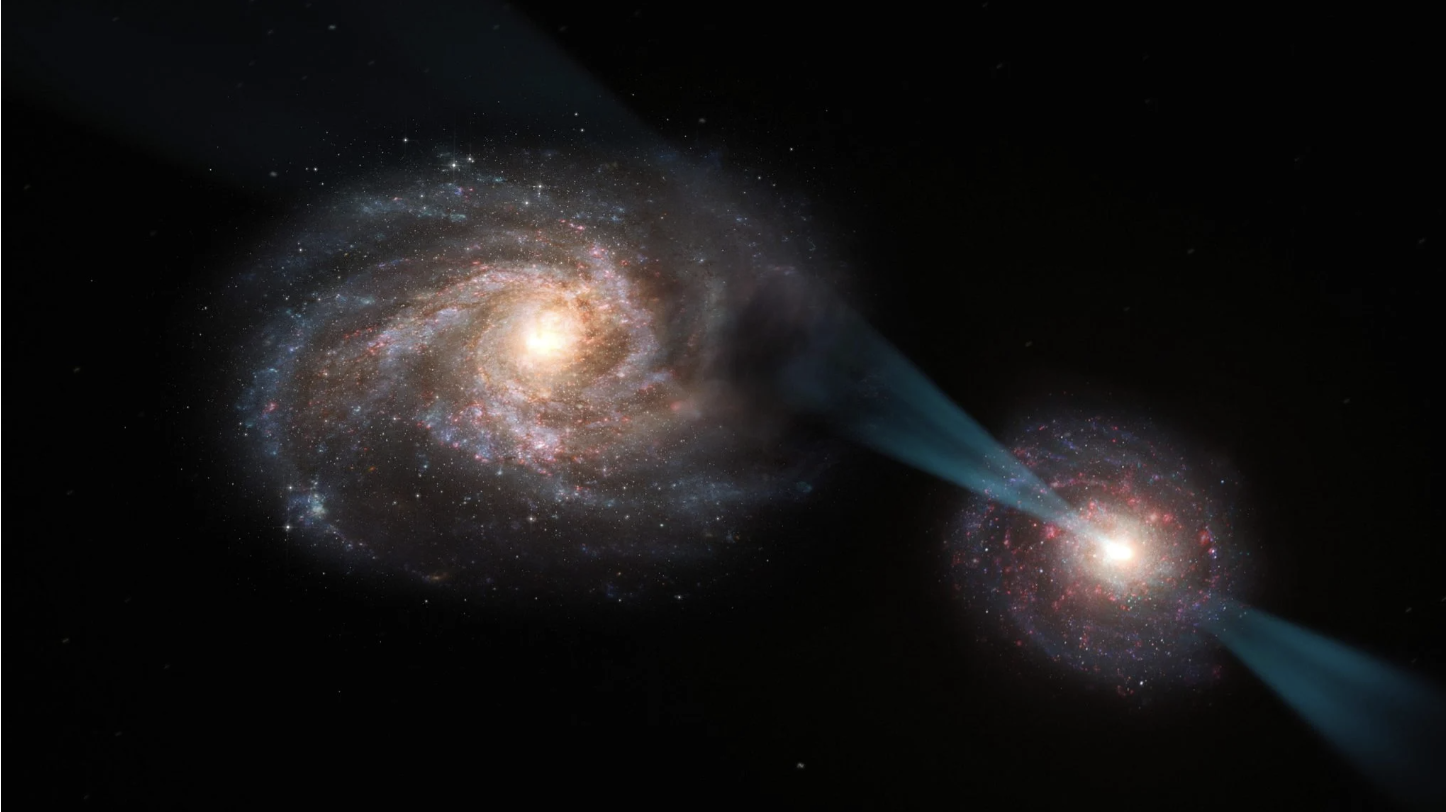
"This artist’s impression shows a ‘cosmic joust’ – a galactic merger in which the galaxy on the right hosts a quasar at its core. This quasar is powered by a supermassive black hole swallowing up material around it and emitting a powerful cone of radiation, piercing the other galaxy like a lance. As this radiation interacts with the galaxy on the left, it disrupts the clouds of gas and dust within, leaving behind only the smallest and densest regions. These regions are likely rendered incapable of star formation after the process. Credit: ESO/M. Kornmesser" (ScitechDaily, Quasar-Powered Galaxy Attack Revealed in Stunning Detail)

Gamma-rays and galactic-scale quantum annealing. 

There are expectations that those neutrinos formed when high-energy gamma rays hit helium atoms nuclei. That thing can tell something about how neutrinos form. There is the possibility that gamma rays push those helium nuclei quantum fields. And then they can form the "droplet" or the bag from that quantum field. That "bag" is the neutrino that travels through the universe. 

If a neutrino's form is very flexible that means there is the possibility that the neutrino puts the fields around them to travel past them with minimum contact or minimum energy transfer. But that is only a hypothesis. The thing that makes neutrinos almost massless is the minimum energy transfer between them and their environment. 

The energy that comes from distant supernovae and quasars can create gamma rays. When we think about things. Like a cosmic gamma-ray background, there is a possibility that things like black holes in the Milky Way disturb that image. The energy that forms in the Milky Way causes annealing in our galaxy dust and gas. 


"Schematic diagram of how neutrinos are produced by the decay of neutrons produced by photolysis of nuclei. Credit: Yasuda et al." (ScitechDaily, The Squid Galaxy’s Black Hole Just Unleashed a Neutrino Storm Without the Light)


"Hubble image of the spiral galaxy NGC 1068. Credit: NASA / ESA / A. van der Hoeven" (ScitechDaily, The Squid Galaxy’s Black Hole Just Unleashed a Neutrino Storm Without the Light)


Sometimes, some galaxies have very active quasars as their companion. Those quasars send high-energy radiation into the galaxy. The power of that energy is so strong that it puts the spiral galaxies's material to anneal. That energy boosts star formation. But it can also make it possible to test things like time dilation in the large-scale environment. The time dilation means that energy flow from particles turns slower. 

And the energy from the quasar raises the energy level in that galaxy. When the environment's energy level rises, energy flow from particles decreases. If the environment reaches the same energy level with particles those particles will vanish. The existence of particles requires that there is a difference in energy levels between the particle and its environment. The energy level in a particle cannot go below the universe's energy minimum. 

An interesting case would be the situation where the jet from another supermassive black hole hits another black hole. Or supermassive black hole's relativistic jets impact with another black hole's relativistic jet. That energy will push every particle into the form of a black hole. That kind of thing can start the quasar formation. Quasars are the first stage in the galaxy formation.


https://scitechdaily.com/quasar-powered-galaxy-attack-revealed-in-stunning-detail/


https://scitechdaily.com/the-squid-galaxys-black-hole-just-unleashed-a-neutrino-storm-without-the-light/


Wednesday, February 1, 2023

Can graviton be two particles?


If we think the theory that that graviton is two particles (like neutrinos). They are orbiting each other so graviton is like positronium, where positron and electron are orbiting each other. This explains why black holes can explode. 

This thing also explains the strange nature of gravitation. In the middle of that particle-pair would be electromagnetic- or quantum low pressure that pulls the quantum field inside it from outside. 

Those particles could also be virtual particles like quantum whirls that are orbiting each other. So virtual particles can act like real particles. And things like black holes can form stable quantum whirls inside them. 

Those particles that are rotating each other can form the quantum tower. A string or wave movement travels in the quantum tower and acts like a heat pump. When it touches other quantum fields it takes a part of them with it. That causes the interaction that keeps the quantum tower in one piece. 

If those particles that are forming graviton will be in series, that thing creates a deeper quantum tunnel through that particle series. The depth of that tunnel determines the level of gravitation. If we would put those rotating particle pairs in a line or row, we could make a very powerful power source. 

When that quantum tunnel stretches the quantum field through it that quantum field interacts with other particles. And it pumps energy into those particle pairs. The requirement that those particle pairs can stay in one entirety is that the virtual particle or electromagnetic low-pressure in the middle of those particles is stable. 

If a graviton is two particles that rotate each other that thing means there is a hole or tunnel in the black hole. That tunnel explains the radiation pike that leaves from the black hole. And then when the energy level of that particle pair increases they send radiation to both sides of them. When that radiation hits the event horizon, that can explain the gravitational waves. 


Above: "An electron and positron orbiting around their common center of mass. An s state has zero angular momentum, so orbiting around each other would mean going straight at each other until the pair of particles is either scattered or annihilated, whichever occurs first. This is a bound quantum state known as positronium" (Wikipedia/positronium). Can some other elementary particles act like electron-positron pair called positronium?


Or there is another very interesting version of the black hole's structure. In that model, the black hole is a WARP bubble. That is this: the black hole is a series of particle pairs that rotate each other. That structure is in the WARP bubble. The WARP-bubble that allows those particle pairs (gravitons) to orbit each other at a speed that is almost over the speed of light. 

The speed of those rotating particle pairs changes. And the reason for that is: that those particles rotate each other with the maximum speed that denies their touch with quantum fields. 

At that moment, the particle pairs will send radiation known as gravitational waves or gravitational radiation. And when the energy level of the black hole decreases its rotating speed decreases. At that moment the outside quantum field pumps energy to that black hole. There is a small electromagnetic vacuum around the standing wave movement that travels out from the black hole's poles. 

The thing that keeps the quantum tower where those particle pairs are rotating in one structure is the quantum low pressure between those particle pairs. When that string or wave movement travels in that quantum tower it pulls wave movement with it. And that thing causes the electromagnetic low pressure between those particle pairs. 

If that low pressure is gone the particle pair explodes. Or that energy load separates that particle-pair. When the level of energy. That travels in that quantum structure turns higher. The distance between those particles expands. 

And then, if that energy pumping ends. That causes the particle pair will be separated. This thing explains the explosion of the black hole. In this model, there is a hole or some kind of tunnel in the black hole. If that tunnel turns too large it explodes the black hole. 


https://en.wikipedia.org/wiki/Positronium


https://artificialintelligenceandindividuals.blogspot.com/

Could there have been UFOs in Earth's orbit in the 1950s?

Aligned, Multiple-Transient Events in the First Palomar Sky Survey could be artificial objects. Or. They could also be some light reflection...