Showing posts with label neutrino. Show all posts

Saturday, January 3, 2026

Sterile neutrino is ruled out.


"A high-precision neutrino experiment has delivered a decisive result that challenges a long-standing explanation for mysterious signals seen in earlier studies. By carefully dissecting how neutrinos transform as they travel, researchers have narrowed the range of viable theories and set the stage for a new phase of investigation. Credit: Stock" (ScitechDaily, A 30-Year Physics Mystery Takes a Sharp Turn: This Bizarre Particle Doesn’t Actually Exist)

A sterile neutrino means a neutrino that formed straight from electromagnetic fields. If that particle exists, that means it formed in the sensor itself. The thing. That can form. The neutrino. Directly from wave movement. Are the Schwinger effect and the wave-particle duality. Even if a sterile neutrino exists, it will not remain sterile. For. A long time. And that means it's almost impossible to confirm those sterile neutrinos. 

Neutrino is the second generation of fermions. Or, sharper saying, neutrinos are members of the lepton family. Leptons are electrons, muons, and tauons. Those particles form in a weak interaction with leptons. We know three types of neutrons. Tau neutrino, electron neutrino and muon neutrino. Those particles are transformations to electrons, tau particles, and muons. 

Or, they form in reactions from muons, taus, and electrons. This means that we don’t actually know neutrinos. This means that. We don’t know. The neutrino that formed in the Schwinger effect. We don’t know. The neutrino, that form. It is direct. In. The wave-particle duality. Neutrinos are formed in the interaction when the weak nuclear force interacts with leptons. 

Sterile neutrino is ruled out, at least for a while. For being sterile, the neutrino must form in a sensor. Otherwise, if a neutrino travels only a short distance, it turns dirty. Neutrino takes quantum fields with it. This means that the neutrino turns dirty. We can call those quantum fields. As “quantum plague”. 

And. Even if a neutrino stays in a static position, it will turn dirty because the “quantum wind” makes it messy. A sterile neutrino cannot exist in our universe, or its existence remains for such a short time. That means we cannot see it. So even if a neutrino forms in the fusion reactor. It turns dirty before it reaches the sensor. The problem with sterile neutrino hunting is that nobody has seen a sterile neutrino. Reseachers see those dirty neutrinos quite often. 


Quantum fields touch those neutrinos. And those fields are left as a plague on those neutrinos that neutrino sensors detect. But the thing that makes it almost impossible to detect and confirm the sterile neutrino is that. The system must know what kind of fields are touched on those neutrinos. So, the system calculates the thickness of that quantum plague. 

If reseachers want to find sterile neutrinos, they must know how much energy, or how thick the quantum layer is through which neutrinos are collected. While their journey to Earth. But. For making those calculations, the system must know the precise point of the Big Bang, or where the neutrinos formed. Then the system must know all quantum fields between the point where the neutrino formed. And then it can calculate the quantum field that is on the neutrino. But as we know, this kind of mission is impossible. Another thing that rules out the existence of the sterile neutrino is the Pauli exclusion principle. 

“In quantum mechanics, the Pauli exclusion principle (German: Pauli-Ausschlussprinzip) states that two or more identical particles with half-integer spins (i.e. fermions) cannot simultaneously occupy the same quantum state within a system that obeys the laws of quantum mechanics. This principle was formulated by Austrian physicist Wolfgang Pauli in 1925 for electrons, and later extended to all fermions with his spin–statistics theorem of 1940.” (Wikipedia, Pauli exclusion principle). 

If. We expand this model to the universe’s scale. That means that because a neutrino is a fermion, there can be only one sterile neutrino in the entire universe. The Pauli exclusion principle means that there are no two fully identical neutrinos in the universe. So, if the sterile neutrino exists, that means there cannot be two of them. All sterile neutrinos. Are identical. That situation is impossible. If. We want to follow the Pauli exclusion principle.  


https://scitechdaily.com/a-30-year-physics-mystery-takes-a-sharp-turn-this-bizarre-particle-doesnt-actually-exist/


https://en.wikipedia.org/wiki/Neutrino


https://en.wikipedia.org/wiki/Pauli_exclusion_principle


https://en.wikipedia.org/wiki/Standard_Model


Friday, November 14, 2025

Researchers are finally solving the mystery of cosmic rays.


"Cosmic rays are high-energy particles, primarily protons and atomic nuclei, that travel through space at nearly the speed of light and constantly bombard Earth from distant cosmic sources. Despite being discovered over a century ago, their origins have remained largely unknown. New research is bringing scientists closer to identifying where these powerful particles are born and how they gain such extreme energies. Credit: SciTechDaily.com" (ScitechDaily, After Over 100 Years, Scientists Are Finally Closing In on the Origins of Cosmic Rays)

Every second, about 100 trillion neutrinos travel through the human body. Most of those neutrinos travel through the human body without touching anything. But there is a theoretical possibility that the neutrino interacts directly with a quark. And that thing can cause an energy impulse. Into liquid. Like neutrinos interact with water molecules in underwater and undersea telescopes. It can interact with water molecules. Anywhere else. We cannot detect that blue light shockwave.  If that impact doesn't happen in complete darkness. 

But that radiation can play. Some role in biological processes. When that impact happens. It sends an energy impulse, which we see as a blue light flash to its environment. Even if that effect is minimal. The effect on things. Like DNA can be like drumming. One impact doesn’t mean a thing. But when. Those impacts happen again and again. That can have. Some kind of effect on the DNA. 

When a neutrino impacts water. It sends a blue light flash. We cannot detect that flash in a normal environment. The problem is that we cannot separate Cherenkov radiation that comes from neutrinos from other particles. Things like protons. And neutrons. And electrons. Could also form Cherenkov radiation when they hit the atmosphere. 


"X-ray image of the newly discovered pulsar wind nebular associated with an extreme Galactic cosmic ray source  the Large High Altitude Air Shower Observatory, LHAASO J0343+5254u, obtained by the XMM-Newton space telescope (DiKerby, Zhang, et al., ApJ, 983, 21). Credit: XMM-Newton space telescope" (ScitechDaily, After Over 100 Years, Scientists Are Finally Closing In on the Origins of Cosmic Rays)

That radiation. Called Cherenkov radiation, turns the sky blue.  As I just wrote. Also, other particles. Then just neutrinos form that blue light flash. That blue light forms when a particle increases its speed and delivers energy. Near nuclear reactors, most of the things that form Cherenkov radiation are neutrons. Neutron involves three quarks, one up and two down quarks. 

When a neutron hits the water at a speed that is higher than the speed of light in water. Neutron’s structure will turn flatter. In that process. It is possible. That is the quark structure in a neutron that can spin around. The structure turns around like a swing. And the up quark sends an energy wave forward. We see that energy as a photon. 

Cosmic rays, or high-energy particles of unknown origin, have been known for over 100 years. Those high-energy particles cause problems with satellites, especially for long-term space flight. The source of the cosmic rays is in natural particle accelerators called PeVatrons. PeVatron-accelerators are supernovae and star remnants that can accelerate particles to speeds. Those are impossible to reach in human-made accelerators. Those particles travel at a speed that is at least 90% of the speed of light. 

Maybe. Those particles follow the spiralic trajectory around some kind of string-shaped energy beam. The primary question in cases like cosmic rays is. How can those particles keep their energy level so high, even if they traveled across the universe from some distant quasars? Why the neutrino will not deliver its energy. That it got from its distant origin. There must be many sources. In and outside our galaxy for those particles. That means. Very high energy objects. Like black holes’ relativistic jets and supernova explosions can press some other particles into neutrinos. At least some of those cosmic radiation particles deliver their energy when they impact a medium or a potential wall. We see that energy as a blue light shockwave. On Earth, neutrinos form in nuclear reactors. 


“Cherenkov radiation glowing in the core of the Advanced Test Reactor at Idaho National Laboratory” (Wikipedia,Cherenkov Radiation)

The supernova SN-1987A was one of the first cases when telescopes detected neutrino bursts. Those bursts are not directly connected with the SN-1987A. But they happened. At the same time as that event. 

But we know that some of those neutrinos travel from quasars. And that raises the question of why those neutrinos are not delivering their energy. One of the First times. When researchers noticed that neutrinos can travel from another galaxy. It was case SN-1987A. That event happened. In the Large Magellanic Cloud. A blue supergiant collapsed and formed that supernova. That supernova  sends neutrinos. That we can see on Earth. Those neutrinos traveled 163,000 light-years to Earth. And their energy level was incredibly high. That causes a thought that could be the shockwave of supernovas. It can somehow turn particles into neutrinos. But the major question is still. Why don’t they deliver their energy? Or if they delivered what was their original energy level? The SN-1987A was a so-called core-collapse supernova that formed a neutron star. 

“SN 1987A appears to be a core-collapse supernova, which should result in a neutron star given the size of the original star. The neutrino data indicate that a compact object did form at the star's core, and astronomers immediately began searching for the collapsed core. The Hubble Space Telescope took images of the supernova regularly from August 1990 without a clear detection of a neutron star.” (Wikipedia,SN 1987A) 

That means it's possible that the blue supergiant was bigger than calculated. It’s possible that it turns into a black hole. The neutrino bursts can be connected to the death throes of that supergiant. Before it collapsed, the star was pulsating very strongly. In that process, the temperature and density in the star’s core rose. That started new fusion reactions. But finally. The fusion material can deliver more energy than it uses. And at that tipping point, the energy production from the star’s core cannot stop its collapse. 


"Figure 1. Distribution of the ultra-high-energy gamma rays (yellow points) detected by the Tibet ASγ experiment in the galactic coordinate system. They are obviously concentrated along the galactic disk. The gray shaded area indicates what is outside of the field of view. The background color shows atomic hydrogen distribution in the galactic coordinates. Credit: NASA" (ScitechDaily, Surprising Evidence for PeVatrons, the Milky Way’s Most Powerful Particle Accelerators)


Wikipedia tells us this about those neutrinos. 

“Approximately two to three hours before the visible light from SN 1987A reached Earth, a burst of neutrinos was observed at three neutrino observatories. This was likely due to neutrino emission, which occurs simultaneously with core collapse, but before visible light is emitted as the shock wave reaches the stellar surface. At 7:35 UT, 12 antineutrinos were detected by Kamiokande II, 8 by IMB, and 5 by Baksan in a burst lasting less than 13 seconds. Approximately three hours earlier, the Mont Blanc liquid scintillator detected a five-neutrino burst, but this is generally believed not to be associated with SN 1987A.” (Wikipedia,SN 1987A)

“The Kamiokande II detection, which at 12 neutrinos had the largest sample population, showed the neutrinos arriving in two distinct pulses. The first pulse at 07:35:35 comprised 9 neutrinos over a period of 1.915 seconds. A second pulse of three neutrinos arrived during a 3.220-second interval from 9.219 to 12.439 seconds after the beginning of the first pulse.” (Wikipedia,SN 1987A)

“Although only 25 neutrinos were detected during the event, it was a significant increase from the previously observed background level. This was the first time neutrinos known to be emitted from a supernova had been observed directly, which marked the beginning of neutrino astronomy. The observations were consistent with theoretical supernova models in which 99% of the energy of the collapse is radiated away in the form of neutrinos. The observations are also consistent with the models' estimates of a total neutrino count of 1058 with a total energy of 1046 joules, i.e., a mean value of some dozens of MeV per neutrino. Billions of neutrinos pass through a square centimeter on Earth. (Wikipedia,SN 1987A)

“The neutrino measurements allowed upper bounds on neutrino mass and charge, as well as the number of flavors of neutrinos and other properties.] For example, the data show that the rest mass of the electron neutrino is < 16 eV/c2 at 95% confidence, which is 30,000 times smaller than the mass of an electron. The data suggest that the total number of neutrino flavors is at most 8, but other observations and experiments give tighter estimates. Many of these results have since been confirmed or tightened by other neutrino experiments, such as more careful analysis of solar neutrinos and atmospheric neutrinos, as well as experiments with artificial neutrino sources” (Wikipedia,SN 1987A)


https://scitechdaily.com/after-over-100-years-scientists-are-finally-closing-in-on-the-origins-of-cosmic-rays/


https://en.wikipedia.org/wiki/Cherenkov_radiation


https://en.wikipedia.org/wiki/Large_Magellanic_Cloud


https://en.wikipedia.org/wiki/Neutrino


https://en.wikipedia.org/wiki/Neutron


https://en.wikipedia.org/wiki/Proton


https://en.wikipedia.org/wiki/Quark


https://en.wikipedia.org/wiki/SN_1987A

Friday, July 25, 2025

The universe, its particles, and quantum fields.


"New research suggests that collapsing stars may serve as natural laboratories to uncover hidden neutrino behavior, with potential implications for the birth of black holes and neutron stars. Credit: Shutterstock" (ScitechDaily, The Universe’s Most Elusive Particles Might Be Talking to Themselves)

Wave-particle duality (WPD) means that particles can turn into energy and vice versa: energy or energy fields can turn into particles. WPD means that particles are only the denser points in the quantum fields. The fact is that the particles require quantum fields for their existence. Without those quantum fields, there is no resistance that can push particles into their form. And that means if we take quantum fields out, energy flows away from particles, ripping them into pieces. And that turns particles into wave movement or quantum fields. Dark energy can form in some sub-particle structures that are too small to detect. 

But anyway, if a particle goes out from the universe, it turns into a wave immediately. And that makes it hard to detect anything outside the universe. The temperature outside the universe is unknown, but it's lower than 3K radiation or Planck radiation. It might be lower than the thermal minimum in the universe. And if that energy level is lower than the thermal minimum, 0K or -273.15C. That means energy can travel only out of the universe. That makes it impossible to observe things outside the universe. 

The most elusive particles in the universe can play an important role in neutron star and black hole formation. 

Neutrinos are almost massless particles. Their interaction with other particles is very weak. And that makes them travel through planets without touching anything. But today, researchers noticed a new interaction between neutrinos. That means a neutrino can interact with other neutrinos. And that makes those elusive particles more interesting than they were before. When a neutrino travels through objects, it takes some part of the quantum fields with it. That means those quantum fields transfer energy to the neutrino when it travels through them. 

Can the gravitational version of the Meissner effect be possible? In that gravitational Meissner effect, gravitational waves act like electromagnetic fields in the Meissner effect. And can this kind of effect also explain why neutrino interaction is so weak? The case where EM-fields travel past the particle that turns them denser than that thing allows the particle tunnel itself through walls? So is the spin of the neutrino so fast that a similar effect to the Meissner effect can make it almost weightless. If a neutrino hovers in an EM-pocket, it's hard to detect. 


"Diagram of the Meissner effect. Magnetic field lines, represented as arrows, are excluded from a superconductor when it is below its critical temperature." (Wikipedia, Meissner-effect) Tc=Temperature Critical. Could there be a similar critical level to gravity?

In the theoretical model, the gravitational waves in extremely dense, fast-spinning particles can act in the same way as electromagnetic fields act in the so-called Meissner effect.  That theoretical phenomenon can be called the gravitational Meissner effect. Or the antigravity. 

If the gravitational Meissner effect exists, that thing can make gravitational levitation possible. The idea is that the fast-spinning particle can turn into a quantum-sized black hole. And that thing makes it possible that gravitational waves travel past the particle. The gravitational Meisner effect can explain some details about black holes. Radiation that travels past those objects closes them inside the radiation bag. So the thing that makes black holes special is that regular and quantum gravity are connected in them. The fast-spinning, extremely dense objects can create a situation where they don't let gravitational waves travel through them. That thing can make the gravitational Meissner effect possible. 

When a neutrino beam travels through the star, that thing can act like airflow that travels through rooms. The neutrino beam takes energy with it. And that decreases the temperature in the star's core. That thing can cause a very dangerous situation when the energy level decreases in the star’s core and the route of the neutrinos. When the energy level decreases, that means the energy that can resist gravity turns lower. And that neutrino beam can cause situations that start to explode sooner than it should. When the energy level decreases, that means the star's outer layers start to fall to its core, and that can cause extreme peaks in the energy production. 

Can a neutrino be the thing that glues quantum and regular gravity together? The idea in quantum gravity is that some kind of radiation or small particles that travel through the particles turns them cold. When something takes energy away from an object, outgoing energy tries to replace that energy. That movement continues until energy levels inside and outside the object are at the same level. In some models, the spin of particles binds quantum fields to them. 

That means particles turned those fields into kinetic energy. The energy that the particle binds pulls other particles to that thing. So, theoretically, a quantum-sized black hole requires that the spin of the particle turns so high. 

When large and dense groups of particles spin, they bind lots of energy into them. Without that spin, that particle’s existence ends. The question is, where do particles put the energy that they store? The outside quantum field pushes structure into its form. If that quantum field turns too weak relative to the structure, the energy that comes out from the structure destroys it. The question is, could the extremely fast-spinning quantum black hole emit gravitational radiation past it? That causes an interesting question about the gravitational Meissner effect's existence. If that Meissner effect's gravitational version exists, that means the gravitational levitation can turn into reality.   


https://bigthink.com/starts-with-a-bang/quantum-fields-quantum-particles/


https://scitechdaily.com/the-universes-most-elusive-particles-might-be-talking-to-themselves/


https://en.wikipedia.org/wiki/Meissner_effect


https://en.wikipedia.org/wiki/Wave%E2%80%93particle_duality


Thursday, May 29, 2025

A giant black hole sent a neutrino beam without a flash of visible light.


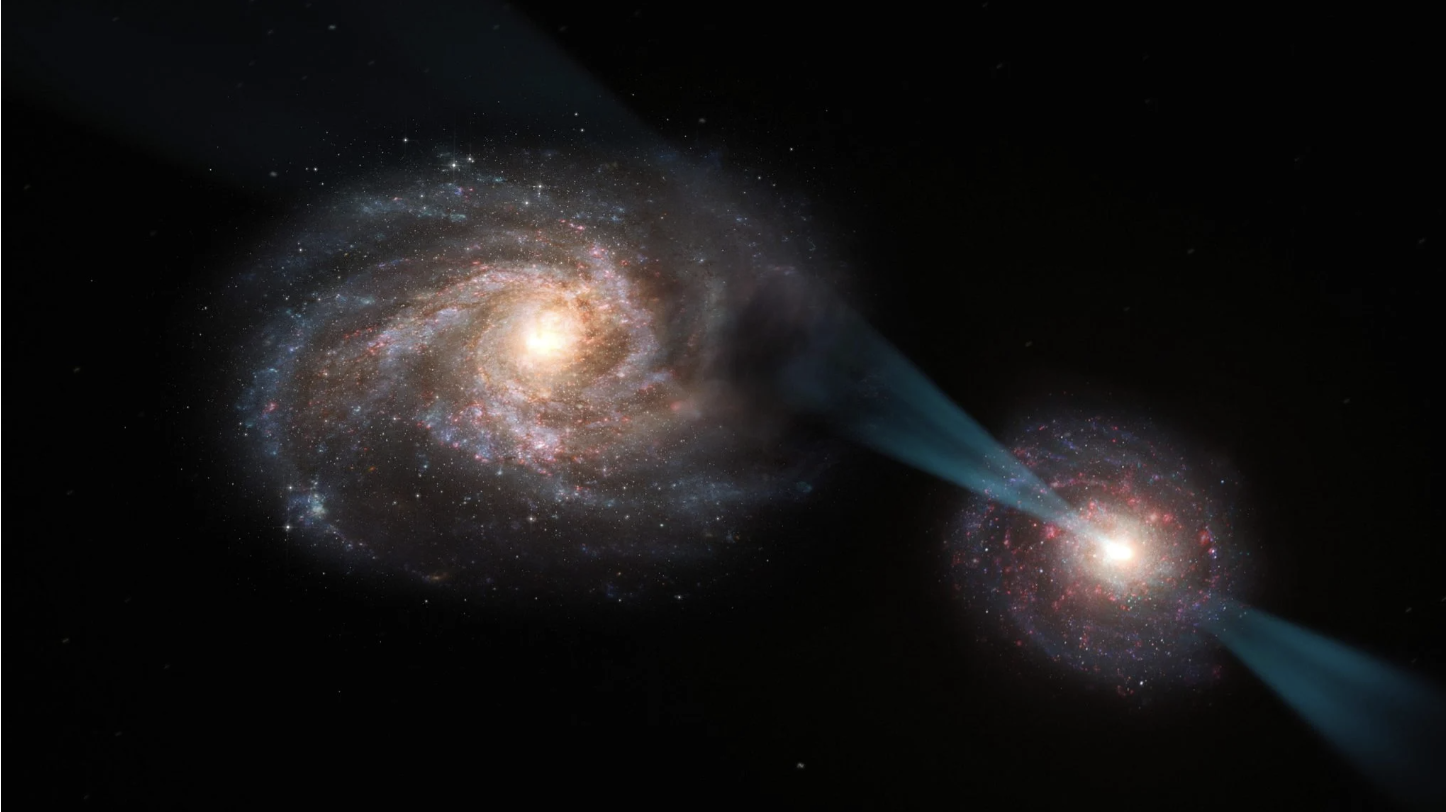
"This artist’s impression shows a ‘cosmic joust’ – a galactic merger in which the galaxy on the right hosts a quasar at its core. This quasar is powered by a supermassive black hole swallowing up material around it and emitting a powerful cone of radiation, piercing the other galaxy like a lance. As this radiation interacts with the galaxy on the left, it disrupts the clouds of gas and dust within, leaving behind only the smallest and densest regions. These regions are likely rendered incapable of star formation after the process. Credit: ESO/M. Kornmesser" (ScitechDaily, Quasar-Powered Galaxy Attack Revealed in Stunning Detail)

Gamma-rays and galactic-scale quantum annealing. 

There are expectations that those neutrinos formed when high-energy gamma rays hit helium atoms nuclei. That thing can tell something about how neutrinos form. There is the possibility that gamma rays push those helium nuclei quantum fields. And then they can form the "droplet" or the bag from that quantum field. That "bag" is the neutrino that travels through the universe. 

If a neutrino's form is very flexible that means there is the possibility that the neutrino puts the fields around them to travel past them with minimum contact or minimum energy transfer. But that is only a hypothesis. The thing that makes neutrinos almost massless is the minimum energy transfer between them and their environment. 

The energy that comes from distant supernovae and quasars can create gamma rays. When we think about things. Like a cosmic gamma-ray background, there is a possibility that things like black holes in the Milky Way disturb that image. The energy that forms in the Milky Way causes annealing in our galaxy dust and gas. 


"Schematic diagram of how neutrinos are produced by the decay of neutrons produced by photolysis of nuclei. Credit: Yasuda et al." (ScitechDaily, The Squid Galaxy’s Black Hole Just Unleashed a Neutrino Storm Without the Light)


"Hubble image of the spiral galaxy NGC 1068. Credit: NASA / ESA / A. van der Hoeven" (ScitechDaily, The Squid Galaxy’s Black Hole Just Unleashed a Neutrino Storm Without the Light)


Sometimes, some galaxies have very active quasars as their companion. Those quasars send high-energy radiation into the galaxy. The power of that energy is so strong that it puts the spiral galaxies's material to anneal. That energy boosts star formation. But it can also make it possible to test things like time dilation in the large-scale environment. The time dilation means that energy flow from particles turns slower. 

And the energy from the quasar raises the energy level in that galaxy. When the environment's energy level rises, energy flow from particles decreases. If the environment reaches the same energy level with particles those particles will vanish. The existence of particles requires that there is a difference in energy levels between the particle and its environment. The energy level in a particle cannot go below the universe's energy minimum. 

An interesting case would be the situation where the jet from another supermassive black hole hits another black hole. Or supermassive black hole's relativistic jets impact with another black hole's relativistic jet. That energy will push every particle into the form of a black hole. That kind of thing can start the quasar formation. Quasars are the first stage in the galaxy formation.


https://scitechdaily.com/quasar-powered-galaxy-attack-revealed-in-stunning-detail/


https://scitechdaily.com/the-squid-galaxys-black-hole-just-unleashed-a-neutrino-storm-without-the-light/


Wednesday, February 8, 2023

Why photons and neutrino interaction with their environment are so weak?


Cherenkov's radiation is forming. In a case, where a neutron or some other particle hits the water or some other thicker medium. Because a neutron has a mass slowing that thing cannot happen immediately. Neutron needs to send their kinetic energy somewhere. And it releases it in the form of a blue light shockwave. Or what happens when we think that thing more accurately? 

When neutrons hit the water. Quarks inside it move forward and hit to neutron's quantum field. That means the neutron's quantum field sends a blue light flash to the water. And that thing means that the particle that is in the WARP bubble acts like those quarks inside the neutron. 

So the quantum field that ties quarks to neutrons forms a short-term WARP bubble that causes a situation. That quarks are crossing the speed of light in a very short moment. And that causes an idea that other particles act similar way but that short-term flash is too short for measurement. 

The neutrinos send similar blue light flashes like neutrons when they hit atoms in neutron detectors. Or actually, those flashes are forming in particles where the neutrino impacts. The reason for that flash is that neutrino moves energy to that atom. And that atom or subatomic particle must release that extra energy, in the form of a blue light flash. The neutrino must precisely impact the subatomic particle so that sensor can detect the flash. 


The question is: why photons and neutrinos are interacting so weakly? 

If energy travels away from the particle very slowly. That makes it hard to detect it.  

The neutrino's energy level may be only a little bit higher than its environment. So that makes the energy flows from that particle extremely slowly. And that means the neutrino is very hard to detect. The reason for that is the wave movement that moves away from the neutrino is so weak that the particle is like a ghost. 

The speed of energy flow away from a particle makes it visible. And energy difference between that particle and its environment determines how fast energy flows away from the particle. 

There is the possibility that a similar effect causes the weak interaction between photons, neutrinos, and their environment. 

The idea is that the particle is like a whisk around the axle. That thing means that in the middle of that whisk-looking structure is particle pair that is forming an axle where the whisk-shaped structure of quantum strings or quantum lightning is forming. So there are two versions of the thing how the quantum field must behave, that it's the interaction is extremely weak. Maybe the first one is the neutrino. And the second one is the photon. 


Neutrino's possible form. 


1) The particle rotates around its axle so fast that there forms electromagnetic low-pressure at its poles. The poles are the head of the axle where the particles are forming. Electromagnetic low-pressure causes the situation that wave movement or the superstrings are falling in the particle from those poles. 

When the particle moves forward. It pulls wave movement inside it. And then the rotation movement pulls the energy out from the sides of that particle. 

Maybe that thing explains why the interaction between the neutrino and its environment is so weak. The reason for that is that the energy that travels away from that particle pushes quantum fields away from it.

And that makes the particle warm so when the particle is warm. Its energy level is higher than its the environment. And that makes it possible to see that particle. The energy or wave movement that travels out from a particle makes it visible. The weak interaction between the neutrino and its environment means that the neutrinos energy level is just a little bit higher than its environment. And that makes the energy flow away from that particle very slowly. 


Photon's possible form. 


2) The energy can travel inside the particle from the sides. There is a small electromagnetic or quantum tornado inside that particle. The wave movement comes out from particles from its poles. That thing forms the radiation pike ahead of the particle. 

This radiation pike pushes the other quantum fields away from the route of that particle. So that structure turns the particle look like stealth. There could be some kind of wrap at the energy pike. And that means there is the possibility that this kind of structure causes a situation that behind the visible photon is some yet unknown particle. 


Could there have been UFOs in Earth's orbit in the 1950s?

Aligned, Multiple-Transient Events in the First Palomar Sky Survey could be artificial objects. Or. They could also be some light reflection...