Monday, January 8, 2024

For the first time, researchers observed a stellar disk in another galaxy.


The image of the star HH1177 system is not very uncommon. Except the system's location is in the Large Magellanic Cloud. This is the first time that a space telescope has taken an image of a star in another galaxy. The material disk around the star HH1177 belongs to a young star. And that shows that there is star formation in those galaxies. 

The Large Magellanic Cloud is the Milky Way's companion galaxy. The existence of the young stars in that galaxy tells that the Milky Way hasn't pulled all gas and dust away from that galaxy. The material disk around the star HH1177 tells that there are also solar systems in the Large Magellanic Cloud and other dwarf galaxies. And that thing opens new visions for the galaxy's evolution. 
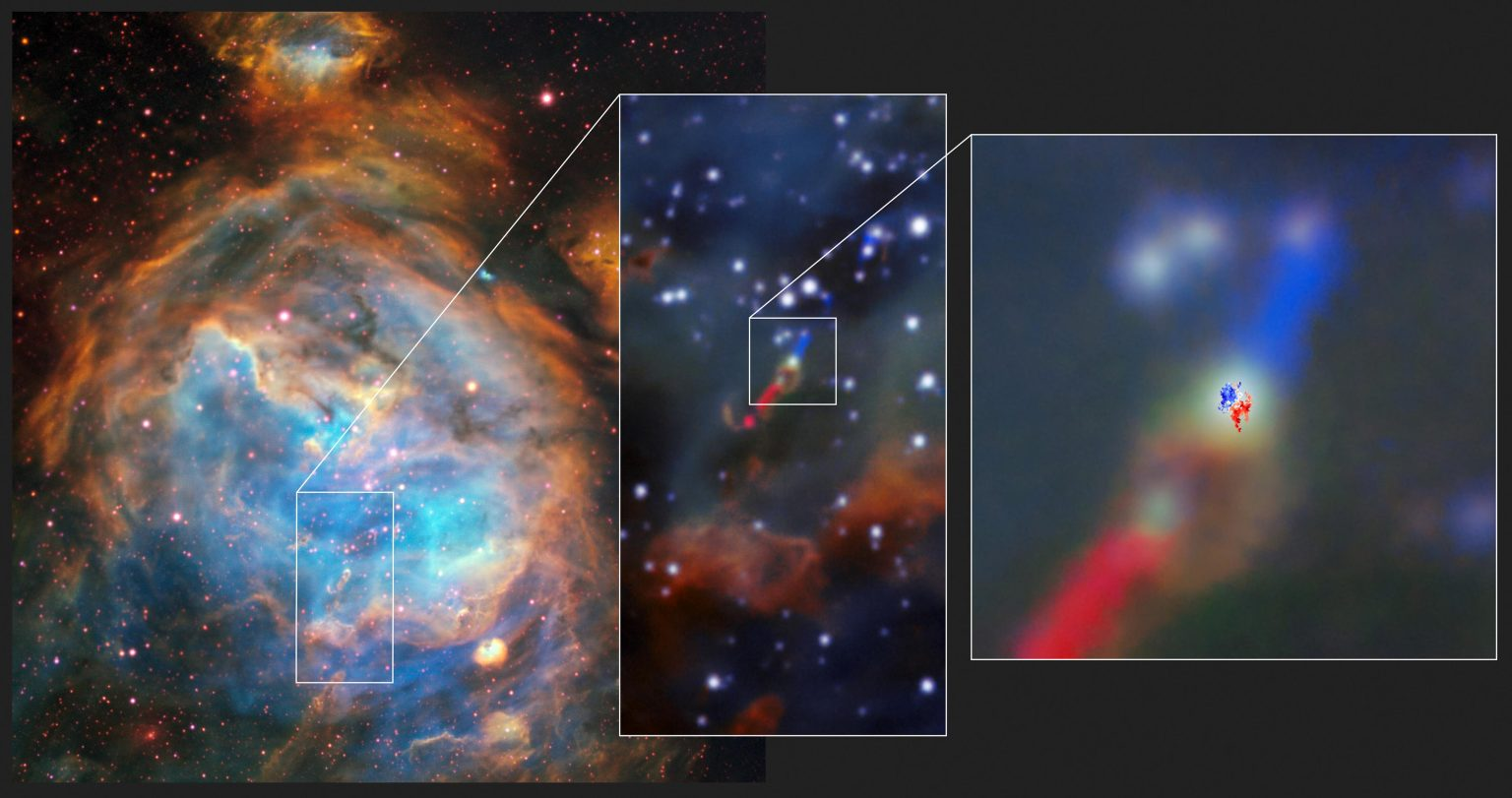

With the combined capabilities of ESO’s Very Large Telescope (VLT) and the Atacama Large Millimeter/submillimeter Array (ALMA), in which ESO is a partner, a disc around a young massive star in another galaxy has been observed. Observations from the Multi Unit Spectroscopic Explorer (MUSE) on the VLT, left, show the parent cloud LHA 120-N 180B in which this system, dubbed HH 1177, was first observed. The image at the center shows the jets that accompany it. The top part of the jet is aimed slightly towards us and thus blueshifted; the bottom one is receding from us and thus redshifted. Observations from ALMA, right, then revealed the rotating disc around the star, similarly with sides moving towards and away from us. Credit: ESO/ALMA (ESO/NAOJ/NRAO)/A. McLeod et al.  (ScitechDaily.com/A Cosmic Breakthrough: Observing an Extragalactic Star’s Disc for the First Time)


"This artist’s impression shows the HH 1177 system, which is located in the Large Magellanic Cloud, a neighboring galaxy of our own. The young and massive stellar object glowing in the center is collecting matter from a dusty disc while also expelling matter in powerful jets. Using the Atacama Large Millimeter/submillimeter Array (ALMA), in which ESO is a partner, a team of astronomers managed to find evidence for the presence of this disc by observing its rotation. This is the first time a disc around a young star — the type of disc identical to those forming planets in our own galaxy — has been discovered in another galaxy. Credit: ESO/M. Kornmesser" (ScitechDaily.com/A Cosmic Breakthrough: Observing an Extragalactic Star’s Disc for the First Time)


"This mosaic shows, at its center, a real image of the young star system HH 1177, in the Large Magellanic Cloud, a galaxy neighboring the Milky Way. The image was obtained with the Multi Unit Spectroscopic Explorer (MUSE) on ESO’s Very Large Telescope (VLT) and shows jets being launched from the star. Researchers then used the Atacama Large Millimeter/submillimeter Array (ALMA), in which ESO is a partner, to find evidence for a disc surrounding the young star. An artist’s impression of the system, showcasing both the jets and the disc, is shown on the right panel. Credit: ESO/A. McLeod et al./M. Kornmesser" (ScitechDaily.com/A Cosmic Breakthrough: Observing an Extragalactic Star’s Disc for the First Time)

Another thing that this kinds of research give is that helps to make models of when planet formation begins in the galaxies. The planets are necessary if researchers want to find lifeforms. If a galaxy comes too soon into the plasma halo of another larger galaxy, it loses its gas and dust. And that thing turns the galaxy into a stellar cluster. there is no star formation. 

An interesting thing is that there could be planets around stars that are in the star clusters. The thing is that until now. Researchers couldn't take straight images from the stars in another galaxy or outside the Milky Way. 

The Large Magellanic cloud has a spiral form. That means there must be some kind of gravity center in that galaxy. It's possible that inside the Large Magellanic Cloud is some kind of black hole. That thing explains why that galaxy still exists. The star formation requires disturbance in the gas cloud. That disturbance makes some kind of whirls. And those whirls turn gas into the stars. 

https://scitechdaily.com/a-cosmic-breakthrough-observing-an-extragalactic-stars-disc-for-the-first-time/

Tuesday, January 2, 2024

Hypothetical Hawking Stars: stars with primordial black holes.

   Hypothetical Hawking Stars: stars with primordial black holes. 


Cold there be black holes in the stars?


"An international research team suggests that “Hawking stars,” stars with central primordial black holes, could mimic normal stars and aid in exploring dark matter and the early universe. Credit: SciTechDaily.com" (ScitechDaily.com/Hawking Stars: What Happens if You Put a Black Hole Into the Sun?)

The hottest star in the night sky is Spica. The star is so hot that somebody says. That somebody says that it should not even exist. Spica is a spectral class "B" star. Only 0,13% of stars have spectral class "B". There are many hotter stars in the universe. The spectral class "O" is the hottest stellar type. "O" is a very unusual stellar class. Only about 0,00003% of stars are Spectral class "O" stars whose surface temperature is over 30,000 K. Those stars are short-living. And their power source is interesting. And in some models, radiation pressure should destroy those super-hot stars in pieces. 

"Artist’s impression of putting a small black hole at the center of the Sun in a thought experiment. Credit: © MPA, background image: Wikimedia/Creative Commons".  (ScitechDaily.com/Hawking Stars: What Happens if You Put a Black Hole Into the Sun?)

So in those stars should be an extremely heavy mass center. And some people suggest that there is a small black hole inside them. That black hole explains why those very hot stars can exist. Stars that get their energy from black holes are called Hawking stars. And the major thing is that Hawking's stars are like other stars from outside. 

Small black holes in the stars can also explain. Why do some of the stars seem to be older than even the universe? The Methuselah (HD 140283) and similar very old stars seem to be about 0,7-0,8 Sun mass. That means they are orange stars. The problem is that they should lose their fuel a long time ago. One explanation for their long existence is small primordial black holes. 


"A simple chart for classifying the main star types using Harvard classification" (Wikipedia/Stellar classification)


The primordial black hole also can explain the fast specific motion of the star Epsilon Indi. That spectral class "K" star is also an X-ray source. That X-ray emission can cause its companions to two brown dwarfs. When particles flow from Epsilon Indi hits those brown dwarfs that causes X-ray emission. But it's possible that the source of that X-ray emission and the material pike of Episilon Indi is a black hole that hovers in Episilon Indi's atmosphere. Or maybe there is a small primordial black hole in that star. 

Theoretically, it's possible. That even in our sun could be Mercury-mass black hole in it. This thing could be the powerful power source for the star. If that black hole exists that star is called Hawking's star. The theory of the Hawking star goes like this: just after the Big Bang before the first stars in the universe formed large groups of small primordial black holes. And then those primordial black holes pulled gas over them. 

"Epsilon Indi with SkyMapper and a Hubble NICMOS image of the brown dwarf binary" (Wikipedia/ Epsilon Indi)

Even a small black hole can exist for a very long time if it's in the space where gas and energy feed it. In Hawking's star, the relativistic jets of the primordial black hole along with its gravity cause a situation. That there happens a nuclear reaction around that black hole. For being stable the black hole should be symmetrically in the middle of the star. 

That means that the first stars would be the Hawking stars. That black hole gave mass-center for those hydrogen clouds. And then. Those hydrogen clouds squeezed into massive blue giants. That thing explains how the first stars formed. And that primordial black hole explains, how the first stars get their mass center that is vital for star formation. 


https://scitechdaily.com/hawking-stars-what-happens-if-you-put-a-black-hole-into-the-sun/


http://stars.astro.illinois.edu/sow/epsind.html


https://en.wikipedia.org/wiki/Epsilon_Indi


https://en.wikipedia.org/wiki/HD_140283


https://en.wikipedia.org/wiki/List_of_oldest_stars


https://en.wikipedia.org/wiki/Spica

Linear space and time.

  Linear space and time. 


The energy level is one of the things that determines time. 


Today we live in linear time. The nature of time is interesting because we know that energy level determines the particle's lifetime. When we say that time moves backward. We mean that the energy level in a particle rises so high that it is similar to the energy level at the point of the black hole's event horizon, the time dilation should turn the time opposite. Same way, when a particle comes closer to the star it gets more energy from those stars. 

And that thing slows its aging. So when a particle travels in space. It travels through the quantum field. Energy can travel into that particle if those quantum fields transfer energy to the particle if those quantum field's energy level is higher than the particle's energy level. And if the quantum field's energy level is lower than the particle's energy level energy travels out from particles. In this model time is an energy level. 


We can say that:


The energy level in the material is the particle's time. Or the time in particle. We can determine time as the existence of particle. Or we can determine it as energy level in particle.  

And the energy level in the universe is environments or space-time. But what is the space-time? In theories, the universe is full of electromagnetic and other fields commonly known as quantum fields. Those quantum fields' energy level is the energy level in the universe. 

When the energy level turns too low, that thing turns particles into wave movement. So we can say that particles are gobs in wave movement. Energy formed those gobs. And energy destroys them. In the same way, we can say that material is a gob of energy.  Theoretically, we can turn material forever by pumping energy into it. Energy pumping to a particle increases its mass. And we can say that wave movement that we probably used acts like wires. Those things fold over particles and turn them into higher mass. 

The problem is that there is no way to stabilize that situation. When the energy level rises higher energy flow from the particle turns faster. If the energy flow out from the particle is fast enough that impulse forms a quantum vacuum around the particle. And that thing can rip particles in pieces. When particle travels near stars they raise their energy level. Then particle travels out from the star's environment. 

Because the energy level in space outside the particle turns lower, that particle releases its energy faster. And if a particle hits another particle, that thing causes a situation in which the energy level of those particles rises very high. And then the energy level decreases very fast. That thing destroys the particles immediately. 

So making material immortal using an outside energy source that pumps energy in particles requires that the system stabilize and replace energy that the system loses when the environment around it turns colder. 

The universe's expansion causes its energy level to turn lower. That means the particle requires more and more energy to keep its energy level. Because the universe expands its energy level decreases. That guarantees that energy or wave movement travels out from the particles. And that decreases those particle's mass. This thing causes someday of those particles to turn into wave movement. 


***************************************************

Cold Dark Matter (CDM) model. 


In CDM model dark matter is extremely low-energy particles. The energy level of those particles would be very close to the energy minimum in our universe. That causes energy to flow into those particles. When energy travels from the visible material into the cold dark matter it forms a small quantum low pressure to the front of the particle. That thing would pull those particles into each other. 

In another model, the WIMP or hypothetical dark matter particle is in a higher energy level than its environment. But the energy difference is so small that energy flow between a particle and its environment is slow. 

But could there particle where there is no energy flow between it and its environment? If a particle's energy level is almost the same as its environment that makes energy flow out from the particle very slowly. In that modified model the dark matter is a higher energy particle than its environment. But the energy difference is so small, that energy flow is impossible to see. 

In the third and the most exciting model, dark matter is particles whose energy level is the same as their environment. There is the possibility that the particle that formed precisely at the same moment as the Big Bang can have the same energy level as its environment. That thing means that there is no energy flow between the environment and particles. And that thing causes a situation in which the particle is almost impossible to detect. 

***************************************************


The hot dark matter would be the material that forms as an example in the relativistic jets. Or on the border between the relativistic jet and its environment. 

That extremely powerful electromagnetic radiation forms the whirls that can turn into yet unknown massive particles. Or those WIMPs (Weakly interacting massive particles) would be virtual particles, short-term quantum whirls that exist in a short moment. 

WIMPs are hypothetical dark matter particles. But could there be some kind of weakly visible particle whose energy level is so low, that it makes energy flow in that particle? If energy flows only in the particle it is invisible. But the question is, where does that hypothetical particle conduct energy? 

Normally when the energy level of a particle rises higher than its environment particle sends energy or wave movement until it reaches energy stability with its environment. In the modern universe energy stability is impossible because the universe's expansion turns the universe's energy level lower. 

But if there is some particle or particle group that formed precisely in the same moment as the Big Bang. That thing can form a particle whose energy level is the same as its environment. And that thing means that there is no energy flow with that particle and its environment. 


***************************************************


Cold dark matter (CDM). And its interaction with visible material. 


The thing. What makes this model interesting is that. Somewhere in the universe is a mystery. Massive gravitational effect called dark matter. Researchers tried to remove that effect. But as we still know, dark matter or unknown gravitational effect remains. The original version of MOND has fallen. MOND (Modified Newtonian Dynamics) was the thing that should explain the universe without dark matter. 

The cold dark matter model or CDM model tries to explain dark matter as material in which the energy level is the same or near the energy minimum. In some models, those dark matter particles are remnants from the universe's early moments. Today we know only two types of elementary particles, bosons and fermions. But in the young universe were probably more than those two types of elementary particles. 

That would make dark matter very hard to detect. So in models, dark matter is the particles whose energy level is very close to the energy minimum. They would be the last stage of particles before they turn into wave movement. If dark matter is that kind of particle. That means it pulls energy out from other particles. This makes dark matter an energy vampire. But that thing is only a hypothesis. And if that hypothesis is true, dark matter can offer unlimited energy sources. 


https://bigthink.com/thinking/a-brief-history-of-linear-time/


https://www.freethink.com/space/dark-matter-mond-theory


https://en.wikipedia.org/wiki/Cold_dark_matter


https://en.wikipedia.org/wiki/Hot_dark_matter 

Sunday, December 31, 2023

Ten years after the Higgs Boson: there are no new particles found.

    Ten years after the Higgs Boson: there are no new particles found. 


In 2012 researchers celebrated that they found Higgs Boson. And after that, there have been ten years without new particles. The Higgs Boson was a boson as calculated, but the problem is that the boson is too light. Otherwise, it matched calculations. And that thing was the scientific sensation. There was one small detail that researchers passed. 

That detail was that in calculations, Higgs Boson required an asteroid-belt-sized mega-accelerator for coming out. That too-light Higgs Boson caused a theory, that maybe the Higgs Boson is still not found. And researchers found some other non-predicted particles that they named Higgs Boson. 


The behavior of the Higgs Boson tells that there could be one or two particles in that boson. Another interesting thing is that there is no force that Higgs boson seems to carry. All other bosons are force carriers. So where is the force, that Higgs Boson should carry? 

Another reason for the problem that Higgs Boson seems to be too light could be that its energy level is so high, and energy flows so fast forming small quantum vacuum or virtual particles around it that it loses its mass faster than predicted. In some other models Higgs Boson hovers in the energy field. And that makes it seem lighter than it should be. When Higgs Boson divides it forms W and Z bosons. That thing tells that the quantum field around that boson travels outside, forming whirls. Some of those whirls are W and Z bosons which are weak nuclear force transportators. So is the original Higgs particle still unseen? 

The next mission of the CERN is to search supersymmetric, high-energy elementary particles. Those researchers hope that they can uncover the secrecy of dark matter. But that thing seems more complicated than nobody expected. Supersymmetric particles are very high-energy versions of well-known particles. The supersymmetric version of quarks is squark. And, supersymmetric version of neutrino is neutralino. But nobody found those particles yet. Theoretical sfermions are supersymmetrical high-energy versions of fermions. The rise of energy level to high enough will turn fermion to sfermion. 

There are four billion collimations for finding a particle called Higgs Boson, we must realize that finding things like WIMP (Weakly Interacting Massive Particles).  And the other, possible supersymmetric particles. The form of WIMP could be that it will somehow tunnel itself through other particles. And that tunneling effect makes it impossible to see those particles. But it's not sure that is a WIMP supersymmetric particle. 


https://home.cern/science/physics/supersymmetry


https://en.wikipedia.org/wiki/Higgs_boson


https://en.wikipedia.org/wiki/Neutralino


https://en.wikipedia.org/wiki/Neutrino


https://en.wikipedia.org/wiki/Sfermion


https://en.wikipedia.org/wiki/Standard_Model


https://en.wikipedia.org/wiki/Weakly_interacting_massive_particle


Saturday, December 30, 2023

Do neutron stars have quark cores?

  Do neutron stars have quark cores? 


"New theoretical analysis places the likelihood of massive neutron stars hiding cores of deconfined quark matter between 80 and 90 percent. The result was reached through massive supercomputer runs utilizing Bayesian statistical inference." (ScitechDaily.com/Neutron Stars’ Inner Mysteries: A Glimpse Into Quark-Matter Cores)

Neutron star's inner cores might involve quark cores. That means there could be also quark stars in the universe. Theoretical models made at the University of Helsinki support the possibility that heavy neutron stars are quark cores. That thing opens a very interesting vision for gravitation and star research. In theoretical models, Magnetars are very light neutron stars. Which shell rotates very fast around its structure. That forms a very strong magnetic field. 

In heavy neutron stars. Gravity locks structure into its entirety. And that makes those heavy neutron stars' magnetic fields weaker but their gravity fields are stronger. That means gravity seems acting like some kind of membrane or strings. That travels between or through neutrons. And that locks the structure into one piece. 


"Artist’s impression of the different layers inside a massive neutron star, with the red circle representing a sizable quark-matter core. Credit: Jyrki Hokkanen, CSC" (ScitechDaily.com/Neutron Stars’ Inner Mysteries: A Glimpse Into Quark-Matter Cores)


Hypothetical quark star: an object intermediate. Between neutron stars and black holes.


We can think that the quark star is an object intermediate between neutron stars and black holes. Nobody has seen that thin yet, so it's a theoretical object. 

The mass of neutron stars determines their quark core's size. And in light neutron stars might not be quark core. Then there would be no quark core or a very small quark core in magnetars. But the part of the pure quark structure in neutron stars rises when their mass rises. And when a collapsing star's mass is high enough all neutrons turn into quarks and form a quark star. 

But then we can continue this thinking game. The idea is that the model can also be in white dwarfs and black holes. So in a very heavy white dwarfs could be neutron stars inside them. In a very heavy quark stars could be back holes in the free quark structure. 


The quark star forms when a neutron star turns too heavy that neutrons can keep their shells. The extreme gravity along with neutron radiation, strips those quantum fields away from the neutrons. That uncovers quarks. And the quark stars would be much denser than neutron stars. Those quarks send their radiation in the wavelength that is the same as the quark's dimension. And that thing could make the quark star almost invisible. 

The quark structure would be far stronger than the neutron structure. That means inside the heaviest quark structures can form a black hole or area where even light cannot escape. And in that model is possible. That those quarks form a symmetrical quark net around that black hole. That quark net could keep that structure in its form. 

In some models, there is the possibility that also gluons can form structures that are similar to quarks. Those gluon stars are hypothetical things, and they are very close to black holes. In some models when a hypothetical quark star massive gravity pushes those quarks so close to each other. That they will push gluons out from that structure. In that model, the quark stars are the only things between black holes and neutron stars. 


Is there gluon stars?

If a quark star exists, is it possible that gluon stars also exist? Gluon is not fermion. But it's a near possible limit that massive gravity and radiation pressure in a supernova form black hole there is a network of gluons near its event horizon. Gluons are gauge bosons. But a black hole's strong gravity and energy load locks those gluons into position making them interact like quarks that are fermions. 

In some other models intensive pressure and heat in high-mass quark stars can form structures where is only quark-gluon or gluon plasma. That kind of structure is a hypothetical thing. 


https://physicsworld.com/a/calculations-point-to-massive-quark-stars/


https://scitechdaily.com/neutron-stars-inner-mysteries-a-glimpse-into-quark-matter-cores/


https://en.wikipedia.org/wiki/Quark_star


Monday, December 25, 2023

Pandora: searching exomoons.

   Pandora: searching exomoons. 


When we make models of another solar system, we use our solar system as a model. That means the gas giants should have moons because most of the planets in our solar system have moons. But we have not yet seen one. The reason for that is that those exoplanets, like gas giants, can be so massive that small moons cannot cause anomalies in their trajectories. And most of the exomoons should be quite small objects. 

If some large, about Earth-size moon, orbits some massive planet or brown dwarf and the system will not make over overpass between its star and Earth, and the moon doesn't travel between its planet or brown dwarf and Earth those kinds of moons are hard to detect. And if that moon orbits bright stars like G-2 or Sun-type stars it's even harder to see. The star's brightness will not decrease if a small planet travels between it and Earth. Also normal stellar activity, like starspots, can cause changes in the star's brightness. 


This artist’s impression shows a gas giant exoplanet orbiting a sun-like star, exemplified by Kepler-1625b. Credit: NASA (ScitechDaily.com/Pandora’s Box of Cosmic Mysteries: Rethinking Giant Exomoons)


"Several influences can create a moon-like signal in a light curve – even without the presence of an actual moon. Credit: MPS/hormesdesign.de" (ScitechDaily.com/Pandora’s Box of Cosmic Mysteries: Rethinking Giant Exomoons)


"Research reveals that giant gas planets in other star systems often make their Earth-like neighbors uninhabitable by disrupting orbits and climates. Unlike Jupiter’s protective role in our solar system, these planets frequently prevent the development of stable, life-supporting conditions, highlighting the exceptional nature of our planetary configuration. Artist’s depiction of an extra-solar system that is crowded with giant planets. Credit: NASA/Dana Berry." (ScitechDaily.com/Chaos Reigns in the Cosmos: How Giant Gas Planets Threaten Life on Nearby Earth-Like Worlds)


Large gas giants can also endanger lifeforms in exoplanet systems. Large and massive exoplanets pull objects to them. And especially in young solar systems cosmic impacts can strip atmospheres off the planets. Also in more mature systems gas giants pull comets and asteroids to them. And the main question is can the large moon host lifeforms? 

The risk of cosmic impacts is higher near large and massive exoplanets. That thing can cause possible lifeforms can form later on those moons. But otherwise, we can say that Titan has also an atmosphere, and we have not seen any devastating impacts with asteroids and Titan. 

We know that in the past that kind of impact destroyed many protoplanets in the chaotic young solar system. One of those impacts, Earth's impact with a large asteroid or protoplanet Theia almost destroyed Earth. Remnants of that impact still exist in Earth's Magma. Also if the exomoon is too close to its giant planet, that planet can strip off its moon's atmosphere. 

But otherwise, the exomoons can have bigger tidal water. And that means they can be good places for life forms and evolution. But there is a possibility that those tidal forces lock the moon to its planet. That means the hypothetical exomoon would always turn the same side to its planet. In that case, the day on that exomoon lasts the same time as its orbiting time. 

Does the planet lock its moon? That depends on the distance of the moon from its planet. In some models. That moon would travel through the planet's shadow. But the moon can have a polar trajectory that can make it possible for an exomoon's rotation time around its axle could be 24 hours. The distance to the exoplanet determines does the moon locks. 


https://scitechdaily.com/chaos-reigns-in-the-cosmos-how-giant-gas-planets-threaten-life-on-nearby-earth-like-worlds/


https://scitechdaily.com/pandoras-box-of-cosmic-mysteries-rethinking-giant-exomoons/

Sunday, December 24, 2023

Relativistic jet: galactic light saber.

   Relativistic jet: galactic light saber. 


"Princeton researchers have found that the M87* black hole expels energy outward, contributing to the formation of massive jets. This discovery, rooted in Einstein’s theory of relativity, challenges traditional views of black holes and could be further tested with advanced telescopes. The study opens new avenues in understanding black hole dynamics, though it stops short of definitively explaining the source of the jets’ power. Credit: SciTechDaily.com" (ScitechDaily.com/Einstein’s Twist: Princeton Astrophysicists Unravel the Mystery of Black Hole Jets and Galactic “Lightsabers”)


"An animation showing how the magnetic field crossing the black hole’s event horizon twists up as as the black hole rotates more quickly. A faster-rotating black hole `winds up’ the magnetic field more quickly, causing the black hole to lose more energy to its surroundings. A team of Princeton astrophysicists observed the wind-up of magnetic field lines in images from the Event Horizon Telescope of the linear polarization from black holes. Credit: Video by George Wong, Institute for Advanced Stud" (ScitechDaily.com/Einstein’s Twist: Princeton Astrophysicists Unravel the Mystery of Black Hole Jets and Galactic “Lightsabers")

It's possible that when a black hole rotates faster and faster. That electromagnetic whirl takes a gravitational field with it. The gravitational field is very much like other fields. And when the electromagnetic field rotates fast enough, the superstrings that form a magnetic field can touch the gravitational superstrings. Or they can collect so many gravitational superstrings that they can take the gravitational field with it. 

The fast-rotating energy fields are like heat pumps. And they transport energy out from black holes. Same way, when a relativistic jet travels through the electromagnetic and gravitational field it transports energy out from the magnetic field and possibly also from the gravitational field. While that jet travels through those fields they pump energy in it. Like laser pumps energy in laser element. 

 Whenever a black hole sends gravitational waves it loses part of its mass. When a black hole's mass gets lower, its size will turn smaller. During that prosess there is forming a small vacuum that pulls energy out from it. 

The relativistic jet of black holes is the most powerful phenomenon in the universe. The power of those jets is enormous. And the Princeton astronomers created the model, of how a black hole's magnetic field, along with gravitation makes those galactic lightsabers possible. The idea is that the particles around a black hole travel to its poles through the transition disk. 

When those particles hit together at the equator. That forms radiation that travels away from the event horizon. The speed of particles that travel and impact with opposite coming particles and particles, that travel in material disk around the black hole is very high. And they involve lots of kinetic energy in those impacts. That means the particles that come from three sides hit together. 

And then, that radiation gives energy to particles that travel to black hole poles. When those particles hit together at the black hole's poles, that thing raises their energy to a very high level. The relativistic jet formation happens near the event horizon. There it collects radiation and particles that fall from space around the black hole. 

It's possible. Those jets can turn particles in the middle of them into so-called parasite black holes. That means there are one or more black holes in the relativistic jets. Those small black holes that can form chains get their energy from the main black hole and its jets. in some visions, there is a gravitational tornado in the black hole's poles. That tornado interacts with its environment like a sonic whirl. 

This gravitational tornado doesn't let another gravitational field get in it. The reason for that is its formation consists of intertwined gravitational superstrings. Those superstrings collect gravitational radiation in their structure. Because that structure has a higher energy level than elsewhere in a black hole, it reflects gravitational radiation. This gravitational tornado denies that a gravitational field cannot fall in that tornado. 

The tornado can tie a gravitational field to its shell. The electromagnetic low pressure in the tornado keeps it in form. And it transfers the wave movement out from the black hole through the poles. That energy that travels to the black hole's poles is the negative energy. That thing transports energy into the polar directions. That maintains the suction that keeps the event horizon in its form. The gravitational tornado acts like a thermal pump that aims energy to the black hole's poles. The main question is does that energy travel straight out from the poles? Or does it travel to the black hole's equator where it impacts with energy that comes from another pole? 

And that thing can create a small non-gravitational area in the black hole's poles. So in this model. Wornholes or Einstein-Rose bridges are inside those jets. Those jets can also form electromagnetic wormholes themselves. The high-power radiation pumps energy to particles that travel in the jets. And that thing can raise those particle's energy levels to a very high level. That makes it possible for those particles to turn into black holes. 


https://scitechdaily.com/einsteins-twist-princeton-astrophysicists-unravel-the-mystery-of-black-hole-jets-and-galactic-lightsabers/

Could there have been UFOs in Earth's orbit in the 1950s?

Aligned, Multiple-Transient Events in the First Palomar Sky Survey could be artificial objects. Or. They could also be some light reflection...