Wednesday, March 6, 2024

Researchers think that the multiverse is not fiction anymore.


Multiverse means that our universe is one of many universes. The reason why researchers and scientists believe that this is true is that logical. About 50 years ago people didn't know that there were other solar systems. Exoplanets were only theories in the 80's. 

About 400 years ago people thought that our Sun was the only star in the universe. Edvin Hubble proved that our galaxy, Milky Way is one of many galaxies. Then researchers found that galaxies form groups, and supergroups. That means that today we think that the universe, where we live is the ultimate supergroup of galactic supergroups. And logically thinking there should be other universes.

We believe that the universe began its existence in an event or series of events called the Big Bang. That event did not begin, because the energy that formed material should come from somewhere. The Big Bang was not one "bang" or explosion. It was a series of events where material took form. Or the energy level that it has today. 

The road from the heliocentric universe to multiverse theory is like matrioshka. We expand our knowledge all the time. And theories travel forward of the observation. 

If we think that the Schwinger effect or wave-particle duality formed all material, we can understand the multiverse's nature better. In interaction where wave movement forms particles, it forms particle-antiparticle pairs. And because they have opposite polarity, that pulls them back together. When material and antimatter face they turn into energy. There was some kind of asymmetry in the young universe. And that asymmetry caused a situation. That there is only one type of material in our universe. When particles hit the atmosphere they form a small number of antimatter particles. 


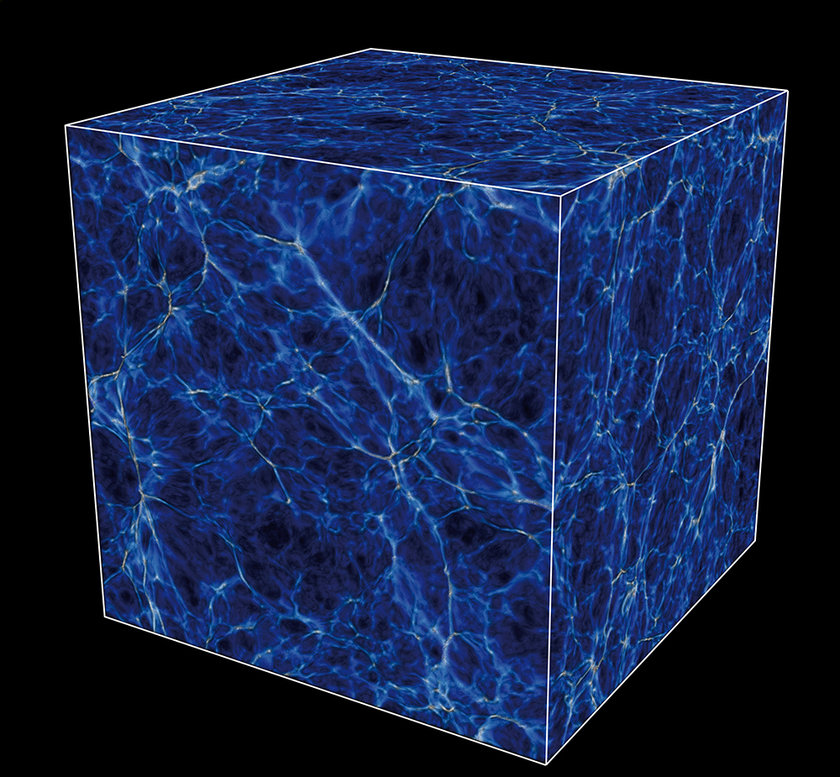
In the image, an inquisitive person breaks the bubble. 


So what caused that asymmetry? The thing that can explain it is that. Some particles came from another universe. In an antimatter universe, all natural laws are similar to our universe. But the material that forms those universes is mirror material. 

The other universes are harder to see than anything else. Light pollution comes from objects in our universe covering those other universes. 

Those other universes must not be similar to our universe. There is the possibility that antimatter forms those other universes. And if they formed in different times, or if their mass is smaller, that thing causes a situation that those universes are invisible to us.


Multiverse explains things like:

Dark energy

Dark matter 

And even the universe's existence. 


In this model universe is the thing. That formed in the crossing point of energy fields that formed in other universes. Dark energy is energy that comes from other universes. 

Dark matter can form clouds and other structures that are similar to visible material. Those dark matter clouds and dark energy are things, that require new models. 

Sometimes researchers think that dark matter is the source of dark energy. And things like low-mass dark matter objects cause theories that maybe some other universes are invisible to us. 

Multiverse explains dark energy and dark matter. That those things can come from other universes. That is one of the most interesting things in multiverse theory.  In multiverse theory, all universes formed from some kind of Big Bang. And that means there should be other universes forming right now. 

Every single universe's mass can be different in the multiverse. And that means time can travel other ways in them. If the universe expands materia turns into wave movement. And if the universe falls the energy level in it turns higher, which means the material turns "younger" because a high energy level in the environment packs wave movement to those particles. 

That is a key element in time. When the universe expands the particles vaporize and energy travels out from the particles. The universe's accelerates and particles turn into wave movement faster and faster. The reason for that is. The difference in energy levels between a particle and its environment turns higher. That increases the speed of energy flow. 

If the universe turns smaller the energy density in it turns higher. That decreases energy flow from particles. The situation the particle reaches the same energy level as its environment, that thing causes the situation particle to melt in its entirety. So being a particle, it requires a different energy level. 


https://bigthink.com/starts-with-a-bang/scientists-think-multiverse-fiction/


Sunday, March 3, 2024

The Brane theory, black holes, and wormholes are the new model for the universe.


The idea in the so-called Brane Theory is that the branes along with superstrings form spacetime. Superstrings are on layers called branes. There are horizontal and vertical "branes" or layers. The horizontal branes are wavelengths, and the vertical branes are energy levels. There are also depth branes or time branes if we want to make that brane model into 3D coordinates. Those branes can be 3D, and one thing that can support the brane model is the Higgs Field. 

Wormholes are hypothetical channels through the universe. Things like cosmic web and GRB, XRB, and FRBs (Gamma, X-ray, and Fast Radio Bursts) are also things. That could support the wormhole theory. In those high-energy bursts, the wave movement could travel like a spiral around the string or wormhole. Same way, cosmic web material seems to pack around some kind of strings. 

The Brane model is the thing that can be used to model the wormhole. Wormhole, or Einstein-Rose bridge is the energy channel whirl or hole in the universe. So where is that hole? The hole is an energy tornado in the Higgs field. That energy tornado is so thick that it denies the formation of the Hall field or transverse energy fields in it. In that case, the energy tornado forms the situation that only its walls transfer energy into the particle. Those transverse fields are not taking energy out from particles. When a particle falls in a wormhole it rides on an energy wave. The wormhole is an energy tunnel through the spacetime. 

All particles and radiation travel at the same speed in a wormhole, the object travels in an energy wave. And that particle cannot release energy into its environment. And that denies the aging of the object. That energy wave that transports particles in the wormhole locks energy in them. And it also locks time in those particles. 


Cosmic web


When we think about forming a wormhole. There is a gravity pothole in the energy field that could be a Higgs Field. When two gravity potholes impact they form a channel through the Higgs field. If we think that intersecting Higgs Fields are the Hall fields. That thing means that the wormhole is the intersecting Hall field that doesn't let any side-coming radiation inside it. 

In a Brane theory, Brane could be Higgs Field. It's the energy level between two particles. If the difference between those particle's energy levels is high enough they will not be able to transmit data to each other. And that means they are in different dimensions. So dimension is the limit between two energy levels where particles can exchange information. 

So if we think that the wormhole is a whirl of water the idea is that if the whirl is deep and we jump in it, we will fall straight through water. The thing that pulls particles through a wormhole is the difference in energy levels between begin and end of the wormhole. When we think about things like stable wormholes long wormholes remain longer time than short wormholes. The speed of energy and material that comes out from that tunnel must be high enough that it will not push energy back into the tunnel. The energy that reflects from the end of the tunnel forms a so-called standing wave and increases entropy. 

Entropy is the thing that destroys the wormhole. It destroys the regular tornados in the atmosphere, and finally, entropy is the thing that destroys the black holes. In a tornado, the outcoming energy keeps the whirl in its form. When the temperature in a tornado increases that thing causes a situation that energy starts to travel through the entire world. In this version, the internal entropy destroys the whirl. If the whirl is too weak, the tornado doesn't form, because the outcoming effect destroys it. And outcoming entropy destroys whirl. So cold tornadoes remain longer. 

Same way gravitational waves form entropy in black holes. Or they talk about entropy inside them. When a wormhole forms between the black holes that turn superposition it forms a channel between them. And because energy can travel only in one direction in wormholes that thing destroys the lower energy black hole. The gravitational waves that travel to lower-mass black holes form entropy. And finally, they detonate that receiving black hole. 

That thing forms the wormhole's other side, a hypothetical white hole. The white hole would be like a donut-shaped formation in the universe. When material comes out from a white hole it forms a shockwave that causes high energy fusion around it. There is a theory that some of the black hole stars were or are some kind of white holes. So if we want to travel through a wormhole, that means we cannot go into a white hole. The particle flow from the white hole would be destructive. 


https://bigthink.com/hard-science/cosmic-web/


https://www.express.co.uk/news/science/996336/Time-travel-albert-einstein-space-time-science-news


https://www.mpg.de/11259384/double-quasars-cosmic-web


https://en.wikipedia.org/wiki/Brane


https://en.wikipedia.org/wiki/Entropy


https://en.wikipedia.org/wiki/White_hole


https://en.wikipedia.org/wiki/Wormhole


https://www.youtube.com/watch?v=AslqA_8ZlDs

When did entropy start?


"An ordered, stable system of particles represents a low-entropy state, whereas a more randomized, energetic system of those same particles is a higher entropy state. Even though the entropy of nearly all systems always increases, that doesn't mean that the entropy of the Universe was initially zero, or even close to it." (BigThink, Did the Universe have zero entropy when it first began?) The lack of entropy makes the particle's movement in the system is harmonic. That means there are no pockets where the system can deliver its energy. 


Many researchers think that there was no entropy at the universe's beginning. That means all material and energy were in nice order, and that thing means that. There was no disorder or uncertainty in the system. At that point, we must realize that the scale in the system is the thing that we use to compare the scale of the entropy. That means the entropy can be large-scale in small systems and small-scale in large systems. When we think about the image that I took from BigThink.com, we can say that at the beginning the universe was in nice order when we look at it in the microscale. 

The thing. What makes entropy interesting is that homogenous systems where there is no internal entropy are more sensitive to outside effects than non-homogenous systems. The reason why glass is broken more easily than steel is that glass is a homogenous material. When something hits the glass, the pressure or energy starts to travel in it. And when one of the silicone atoms in the glass starts to oscillate.  

It transforms that oscillation into other silicone atoms. That causes a harmonic reaction, which pushes atoms away from each other and breaks chemical bonds. In steel, there are pockets where energy moves. When something hits steel. Iron transfers that movement into carbon. The lack of harmonic motion makes steel more tenacious than pure iron. 

And the thing that causes entropy is energy that falls between particles. There is more energy in pure iron. That falls between particles than in steel. In homogenous systems, the entirety pulls more energy in layers than in heterogeneous systems.  That energy causes more disorder between elements in homogenous structures. 

In that model the universe was in nice little layers there everything was homogenous. But in the macro scale, there was entropy. That means the universe had zero entropy when somebody looks at it vertically or from outside. But if somebody cuts the universe in two parts there is an onion-shaped structure. And a large scale there is uncertainty. That means entropy or uncertainty in the system can be numerically small, but its size can be dominant. 

The layers were entropic to each other. That means the different layers pushed each other away. Or vacuum at the outside of the structure pulled the upper layers away from the inner layers. And because the number of particles was not unlimited. There formed holes between particles. 

That caused their quantum fields to jump outwards forming the small standing waves or "quantum electric arcs". Those particles pushed against each other. And then there formed holes that pull structures from layers below them. The energy always travels from higher to lower energy levels. The hole at the upper structure pulls energy into it from the lower structure. That thing is devastating. When energy pushes particles away from each other there is more and more space between particles. And there falls more and more energy between those particles. 

When we think about particles, we can call them structures. There are always structures in the material. Even on the tiniest scale, there are structures like superstrings. Those superstrings are small bites of wave motion. The diameter and length of them are always different. And that forms empty points between them. That makes them oscillate. That movement releases free energy in the system. That means the material is like yarn balls. And if those yarn balls are in a vacuum that pulls the outer shell away. That thing forms pockets where internal superstrings transport energy which is the sub-wave movement. 


Increasing entropy destroys black holes. 


The mystery of gravitational waves is this: is their origin in particles or are those gravitational waves other wave subwaves? 

If we think that image again even the densiest objects have entropy. The reason for that is that the energy or radiation and particles do not affect it symmetrically. We can think that the black hole's gravity fields are like segments in a ball. The segment pulls material smaller, and the size of the black hole's nucleus turns bigger. In that model, there is a precise point in the black hole's nucleus where energy hits. And that causes asymmetry in energy production or energy release. Those impacts send wave movement through black holes. And that causes the effect called vaporization. 

We can see that vaporization as gravitational waves. The gravity wave's origin is in the oscillation in the black hole. When a black hole oscillates its event horizon changes its place. And when a black hole turns smaller it leaves very high energy particles and wave motion behind it. The main problem with gravity radiation is, does it comes from particles or straight from wave movement. In that model, the gravitational waves are the sub-waves. Whose origin is in another wave movement. 


https://bigthink.com/starts-with-a-bang/universe-zero-entropy/

https://en.wikipedia.org/wiki/Entropy


Wednesday, February 21, 2024

Black holes are the brightest objects in the universe.


"This artist’s impression shows the record-breaking quasar J059-4351, the bright core of a distant galaxy that is powered by a supermassive black hole. Using ESO’s Very Large Telescope (VLT) in Chile, this quasar has been found to be the most luminous object known in the Universe to date. The supermassive black hole, seen here pulling in surrounding matter, has a mass 17 billion times that of the Sun and is growing in mass by the equivalent of another Sun per day, making it the fastest-growing black hole ever known. Credit: ESO/M. Kornmesser" (ScitechDaily, Brightest Object in the Universe Discovered – Powered by Supermassive Black Hole Eating a Sun a Day)


The brightest object in the universe eats a sun in a day. That supermassive black hole is in quasar J059-4351. The paradox is that the black holes are the brightest objects in the universe. The paradox is that the black hole itself will not send any radiation, but its transition or material disks are very bright. 


The Sagittarius A* gives new data about the time dilation and speed of light.


Supermassive black holes are the most powerful objects in the universe. Things like rotation speed or spin is the thing that makes supermassive black holes interesting. The spin of the Sagittarius A*, or Sgr A* is about 60% of the speed of light. When material falls into the supermassive black hole, it forms a transition disk, the spiral structure around the mass center. The spiral continues behind the event horizon, or the point. Where escaping velocity crosses the speed of light. 

That means inside the event horizon photon and other particles travel with the same speed. The speed of photons is higher than other photons because the massive gravity effect pulls it from the front side. When a particle closes the black hole, massive gravity starts to pull it into a form that looks like spaghetti. This effect will turn things like quarks into elongated things. 

When we think that black holes are like potholes, that gravitational pothole turns the universe smaller. The reason for that effect is this black hole collects more information into that pothole. There is no reflection because all photons and other material and wave movement travel into the black holes. And the last particle that can escape from the massive gravity is the photon. 

Black holes also prevent the Hall fields or potential walls from forming because they pull all energy inside it. Some electrons and photons whirl around the event horizon. Those whirling particles get their energy from the material disk, which sends radiation also inside the black hole. That raises those particle's energy levels to extremely high. 


"This artist’s illustration shows a cross-section of the supermassive black hole and surrounding material in the center of our galaxy. The black sphere in the center represents the event horizon of the black hole, the point of no return from which nothing, not even light, can escape. Looking at the spinning black hole from the side, as depicted in this illustration, the surrounding spacetime is shaped like an American football. The yellow-orange material to either side represents gas swirling around the black hole. This material inevitably plunges towards the black hole and crosses the event horizon once it falls inside the football shape. The area inside the football shape but outside the event horizon is therefore depicted as a cavity. The blue blobs show jets firing away from the poles of the spinning black hole. Credit: NASA/CXC/M.Weiss" (ScitechDaily, Warp Speed Ahead: How Our Galaxy’s Black Hole Bends Spacetime)

One reason for high-power gamma- and X-ray impulses is in the relativistic jet. When particles at the edge of a relativistic jet and the jet's energy fields interact with gas around the black hole, that effect forms intensive high-energy radiation. The radiation forms when energy from those particles and energy fields transfers into the material disk. When particles hit that material cloud they deliver energy. And that energy transfer is the thing, that forms gamma- and X-rays. 

The weight of the Sgr A* is over four million suns. Accurately its mass is 4,30 million suns. Still, that thing is like a rugby ball. There is the possibility that the relativistic jet pulls the Sgr A*'s energy fields with it. And that forms a cosmic vacuum that stretches the black hole. Or some kind of energy tunnel travels through the black hole. In the third model, the fast spin curves the gravity fields, and that causes the rugby-ball-shaped structure. That means gravity in its poles is a little bit weaker than in other points in it. 


There is suspicion that hypothetical Hawking's radiation forms when those photons in hyper-high energy levels make a superposition. The requirement for that is this: the other electron or photon is in a different energy level. And they oscillate with the same frequency. The idea is that the lower photon (or electron if that thing is an electron pair) has a lower energy level because a black hole pulls energy out from it. 

At the point of the event horizon, gravitational waves can also orbit the black hole. Standing gravitational waves can transport energy into the particles or other wave movements that travel through the event horizon. So Hawking radiation can come from the energy bridges between superpositioned and entangled particles. And because the radiation comes from the end of those energy bridges its wavelength is very small and wave rise is not very high.  

The standing gravitational waves that harvest energy from their environment can turn very high energy levels. In that model, gravitational waves interact like all other wave movements. That means higher energy gravitational waves transport energy to the lower energy gravitational waves. And they also can push those gravitational waves away. That thing can explain why black holes send wave movement. 

When those superpositioned particles touch the event horizon their energy positions change places suddenly. The lower energy particle turns suddenly into a higher energy participant of the quantum entanglement. That thing sends an energy impulse to the upper particle. So that means Hawking radiation can come from that kind of photon pairs or energy bridges between them. 


It's possible. That event horizon can transport energy into the energy bridge that travels between superpositioned and entangled particles. 


When those superpositioned particles fall into the black hole through the event horizon the energy level of the lower photon turns suddenly higher, and that sends an impulse through the energy bridge when that thing travels through the event horizon. In that model, the other photon pumps energy to the photon that was in a higher energy level just before the lower photon touches the event horizon. 

A black hole's speed cannot cross the speed of light if we look at the things outside the event horizon. But as we know speed is also energy. The thing is that the virtual crossing at the speed of light is possible. In that case, the outside energy that impacts the particle along with the kinetic energy can raise its energy level to a level that is higher than the speed of light causes. 

Kinetic energy is wave movement that the particle traps. When a particle travels in the universe, quantum fields touch it like plaque. That plaque is the kinetic energy. The reason why particles cannot cross the speed of light is that in the critical moment, the energy jumps away from the particle and starts to travel to the environment. This thing denies crossing the cosmic speed limit. 

But virtually crossing the speed of light is a very easy thing. At the quantum level. Speed is similar to in our size world. That means the same rules that affect vehicles like cars can used for modeling speed and impacts of subatomic particles. 

The thing is that when two particles like electrons impact with speed of 60% of the speed of light, the impact speed is 120% of the speed of light. In that case, a high energy level causes virtual crossing at the speed of light. In the same way, objects can hit denser energy fields at extremely high speeds. And that thing could load more energy into it than it normally does. 

The reason why anything that has mass cannot cross the speed of light can be the same as the thing. That nothing that has no mass, cannot have unlimited slowing speed. When particles like electrons travel in a vacuum and then suddenly hit the water they take that impact into their quantum field. The electron's internal structure jumps forward and that movement in the quantum field causes photon's formation. 

One down quark and two up quarks form the proton. In neutron, there are two down and one up quark. Those quarks form a structure, that looks like a trapeze. In that structure, one quark hangs between two quarks. In a proton, two up quarks hang one down quark. When a proton or neutron hits water with its maximum speed one quark jumps forward and starts to rotate around those structures. 

That rotation movement is like a bolt that we can rotate between our hands keeping the wire from both ends. That movement pumps energy out from the proton. When a particle moves energy into its environment. It must form a photon. And then that photon transports energy out from that particle. That is the thing, that we see as Cherenkov radiation. 


https://scitechdaily.com/brightest-object-in-the-universe-discovered-powered-by-supermassive-black-hole-eating-a-sun-a-day/


https://scitechdaily.com/warp-speed-ahead-how-our-galaxys-black-hole-bends-spacetime/


https://learningmachines9.wordpress.com/2024/02/21/black-holes-are-the-brightest-objects-in-the-universe/


Saturday, February 3, 2024

The confirmation of quark material existence is on the door.


"Artist’s impression of the different layers inside a massive neutron star, with the red circle representing a sizable quark-matter core. (Image: Jyrki Hokkanen, CSC)" (University of  Helsinki, Further evidence for quark matter cores in massive neutron stars)


The models created for neutron stars can be used to model still hypothetical quark stars. 


Researchers at the University of Helsinki are close to proving the existence of an exotic material called quark material. That material existence in extremely heavy neutron stars is almost confirmed. Now we can say that this material opens the path to finding a new star type called quark stars.  The quark stars would be objects between black holes and neutron stars. 

The quark star forms during a supernova explosion and melts protons and neutrons together. And that reaction forms material where only quarks exist. The quark stars' rotation would be very fast. That rotation where centripetal force resists gravity is the requirement that a quark star will not fall into a black hole. 

And if that rotation ends, the quark star will fall into a black hole. The quark material is the strongest known material in the universe if it exists. When neutrons and protons make so-called quantum fusion, where proton and neutron melt into one entirety. That reaction delivers more energy than people think. It's possible that around the quark star forms a small cosmic void, that can rip the quark star in pieces. 

The biggest difference between a neutron star and a quark star is in the reaction that forms the star. In neutron stars electrons impact with protons. This reaction turns protons and electrons into neutrons. In still hypothetical quark stars neutrons impact with protons. The other model is that the neutrons impact with other neutrons. In that model, the shockwave falls in the supernova explosion. With gravity pulls or pushes neutrons together. 


Quark stars may have a homogenous structure. That means the quark star's shell and core rotate at the same speed. This thing makes its magnetic field quite weak. 


In that model, the quark star's shell and its core have the same rotation speed. That thing probably denies the form of the magnetic field. Or quark star's interaction with plasma around it forms a magnetic field. The quark stars are hypothetical forms. And for that structure, we can use the same models with neutron stars. 

The high-speed rotation of that structure turns quantum fields in the direction of the rotation axle. And that thing turns quantum fields to the sideways from the orbiter. That could explain material disks and the relativistic jets. The plasma that orbits the black hole forms its magnetic field. 

But if we think that the hypothetical quark stars are even heavier or something slows their rotation too much. That thing causes an effect where quarks press together into one entirety. When quarks that form quark stars melt together, the fall of the structure pulls quantum fields against that object. This thing forms a black hole. In black holes. The magnetic field forms when plasma whirls around the relativistic jet at different speeds. 

XXXXXXXXXXXXXXXXXXXXXXXXXXXXXXXXXXXXXXXXXXXXXXXXXXXXXXXXX

Are quark stars the thing that is behind the FRBs (the fast radio bursts)? 


But then back to the quark stars. Quark stars may not have a very strong magnetic field. The reason for that is that there is a possibility that quark stars are homogenous structures. The free quarks in the quark star's nucleus can be called quark gas. 

Otherwise, there could be free quarks, the quark gas in the structure. Those free quarks can form a stronger magnetic field than any magnetar can form. The reason why I believe in homogenous structure is that. There is no evidence of the quark star pulsar. It's still possible that a fast-rotating quark star's centripetal force pulls those quarks away from each other. And that could be from that quark gas. So could the quark stars be behind the FRB:s. That fast rotation theory, where extremely fast rotation forms free quarks in quarks stars explains why those FRBs:s happen suddenly. 

XXXXXXXXXXXXXXXXXXXXXXXXXXXXXXXXXXXXXXXXXXXXXXXXXXXXXXXXX

In neutron stars, the lightest neutron stars have the strongest magnetic fields. 


The neutron star's shell's rotation speed compared to its core's rotation speed is the thing that determines the power of the magnetic field. The neutron star's shell acts the same way as a generator. 

The difference between its shell and core speed is lower in heavy neutron stars. That means their magnetic field is weaker than light neutron stars called magnetars. 

There is a possibility that in some cases the reason for the FRB is that the magnetar's shell will start to rotate in an opposite direction than its shell. In that case, the magnetar's magnetic field turns extremely strong. Things like black holes and neutron stars that are part of binary stars can open this mystery. And maybe someday, we can find the most exotic star in the universe, the object that forms pure quarks. This is one thing that can help solve the mysteries in the universe. 


https://www.helsinki.fi/en/news/human-centric-technology/further-evidence-quark-matter-cores-massive-neutron-stars


https://www.universetoday.com/130031/what-are-quark-stars/


https://en.wikipedia.org/wiki/Quark_star


https://learningmachines9.wordpress.com/2024/02/04/the-confirmation-of-quark-material-existence-is-on-the-door/


Almost invisible galaxy challenges dark matter theories.

"The discovery of Nube, a faint and extended dwarf galaxy, challenges existing astrophysical models. Its unique characteristics might provide new insights into the universe and the nature of dark matter. (Artist’s concept.) Credit: SciTechDaily.com" (ScitechDaily, Ghost in the Cosmos: Almost Invisible Galaxy Challenges Dark Matter Model)


"“One possibility which is attractive, is that the unusual properties of Nube are showing us that the particles which make up dark matter have an extremely small mass” (ScitechDaily, Ghost in the Cosmos: Almost Invisible Galaxy Challenges Dark Matter Model)) 

Spanish astronomers made new fundamental observations of a dwarf galaxy called "Nube". That galaxy is almost invisible. And that thing makes it interesting. The new observations caused astronomers to introduce that dark matter has an extremely small mass. If hypothetical WIMPs weakly interacting massive particles are small-size particles with extremely slow spin, that thing can explain why that matter is impossible to detect. 

There is the possibility that the shape of the WIMP is so high energy that it tunnels itself even through elementary particles. In some other models, dark matter particles' energy level is so low, that it pulls energy into itself. And if energy flows only to the object, that makes it invisible. So in that case, the dark energy is the radiation that reflects from dark matter particles core. 

"The measurements of dark matter are made by observing gravitational lensing. And another way to measure the invisible is to calculate some object's mass. Then the system calculates the predicted rotation speed. And then compile it with the observations. Those observations tell if there is more material than there should be." (ScitechDaily, Ghost in the Cosmos: Almost Invisible Galaxy Challenges Dark Matter Model)


"The Nube galaxy. The figure is a composition of a colour image and a black and white image, to pick out the background. Credit: GTC/Mireia Montes" (ScitechDaily, Ghost in the Cosmos: Almost Invisible Galaxy Challenges Dark Matter Model)


So WIMP is a lightweight particle that looks like quarks or leptons. But it's smaller than them. The forms of dark matter are a mystery. And in some visions the dark matter particle WIMPs could be particles that orbit electrons. New observations about galaxies and black holes challenging traditional cosmological models. 

The interaction between dark matter and visible material is purely gravitational. But if the relation between WIMP's size and electron is the same as electron and proton. That could explain, why the only known interaction between dark matter and visible matter is gravitational. 

There are galaxies with dark matter and galaxies with no dark matter. That thing tells us that dark matter is not distributed evenly. This means that dark matter can form structures similar to cosmic nebulas. Or it's possible.  That dark matter can form planets, that are invisible to us. 

Dark matter is a fascinating thing. The invisible matter. But can interact through gravity. There is a theory that energy level determines what its name is. So the lepton's energy level determines if it's an electron or muon. The same way the energy level determines is particle down or top quark. That means that it's possible. That energy level determines whether can we see particles or not. 


https://scitechdaily.com/ghost-in-the-cosmos-almost-invisible-galaxy-challenges-dark-matter-model/

https://learningmachines9.wordpress.com/2024/02/03/almost-invisible-galaxy-challenges-dark-matter-theories/

Thursday, February 1, 2024

The slow stars around the Milky Way cause problems with dark matter theories.

" New research by MIT reveals that stars at the edge of the Milky Way move slower than anticipated, implying the galaxy’s core may contain less dark matter, challenging current astronomical theories. Credit: SciTechDaily.com" (ScitechDaily, Galactic Surprise: Milky Way’s Slower Outer Stars Suggest Dark Matter Overestimated)


The question of dark matter existence is interesting, and new observations challenge that theory. The prime question about dark matter is that nobody has any contact or observations about that thing, that causes gravitational effect. The thing that could explain why stars near the Milky Way edge behave as they behave is that there is less dark matter than researchers expected. 


Do stars around other galaxies act like those slow stars at the edge of the Milky Way?


Or the dark matter distribution around the galaxy is different than thought. Maybe dark matter forms larger or denser gobs around black holes than researchers calculated. And that means there is more dark matter around the center of the galaxy. And uneven distribution of that thing causes stars to move slower than they should at the edge of the Milky Way. 


What can also cause a dark gravitational effect than theoretical dark matter?   


If we think that the nature of gravity is it interacts with the environment. That thing can explain why there is a dark gravity effect. That source is unknown. In that model, some very thin energy beams act like thermal pumps that pull energy with them. That means the relativistic jets near black holes can explain that dark gravity effect. When a relativistic jet travels in the universe, that thing pulls energy with it. That causes a situation where quantum fields or energy around a relativistic jet falls to that jet. 

So if relativistic jets are longer than researchers calculated. That can form a situation, where gravity doesn't interact as calculated. Same way if some kind of beam travels through the universe that thing causes a similar effect to a thermal pump or relativistic jet. The colder areas in the microwave background show that some super-powerful relativistic jets may travel through the universe. 


Cosmic microwave background 


"Maybe" is a keyword in dark matter. 


And the reason for that is nobody has seen dark matter. There is the theory of WIMPs (Weakly Interacting Massive particles). But nobody saw any WIMP yet. So that causes questions about the dark matter existence. We know that the gravitational effect exists. In some models, WIMPs are quantum or atom-size black holes. Or maybe, there are just more black holes in the Milky Way than expected. 

WIMPs (Weakly Interacting Massive Particles) may be virtual particles. The energy whirls, standing gravity waves, and small cosmic voids can act like particles. 

But nobody knows the source of that effect. And that's why the dark matter should rename as "dark gravity". The question is what can cause a dark gravitational effect? The key question is what kind of particles are invisible? In some models, dark matter is an ordinary material that travels in energy beams of black holes. 

Those gamma- and X-rays can input very high energy levels in particles that travel in them. And that thing turns the energy level, and those particles' mass turns higher than it should be. When those particles travel out from those relativistic jets they release their energy as energy bursts. And that thing can connect those particles with dark energy. 

Another way standing gravitational waves can form a point that looks like a particle. Or maybe the small cosmic voids are the thing that forms dark matter. When those cosmic voids collapse they pull energy or quantum fields inside them. And then those quantum fields reflect from inside that thing. Those things can also explain dark energy. 


https://scitechdaily.com/galactic-surprise-milky-ways-slower-outer-stars-suggest-dark-matter-overestimated/

Could there have been UFOs in Earth's orbit in the 1950s?

Aligned, Multiple-Transient Events in the First Palomar Sky Survey could be artificial objects. Or. They could also be some light reflection...